

Custom collapsible rigid boxes are premium packaging structures built from high-density chipboard. They ship flat - stacked like panels - and fold into full three-dimensional form in under a minute, with no glue or tools required. For brands manufacturing overseas and importing at volume, that structural difference is one of the most consequential decisions in the packaging spec process.
The core value proposition is simple: a pre-assembled rigid box ships at its full cubic volume whether it contains product or not. A collapsible version of the same box ships at a fraction of that volume and expands at your warehouse or 3PL. The end customer sees an identical box, with identical corners, identical weight, and the same tactile quality they associate with luxury retail packaging.
What Is a Collapsible Rigid Box - and How Does It Differ from a Traditional Set-Up Box?
A traditional set-up box is permanently bonded into shape during manufacturing and arrives at your warehouse already assembled - meaning freight carriers charge for its full cubic volume whether it contains product or not. A collapsible rigid box solves this with precision crease lines and magnetic or adhesive corner anchors: it travels flat, then pops into its final shape at the fulfillment stage with the same square corners and tactile rigidity of any well-made rigid box.
Quality comes down to three variables: chipboard density (typically 1,200–2,000 gsm), the wrapping paper bond, and the precision of the corner scoring. When all three are correctly calibrated, the collapsible mechanism is invisible to the end customer.
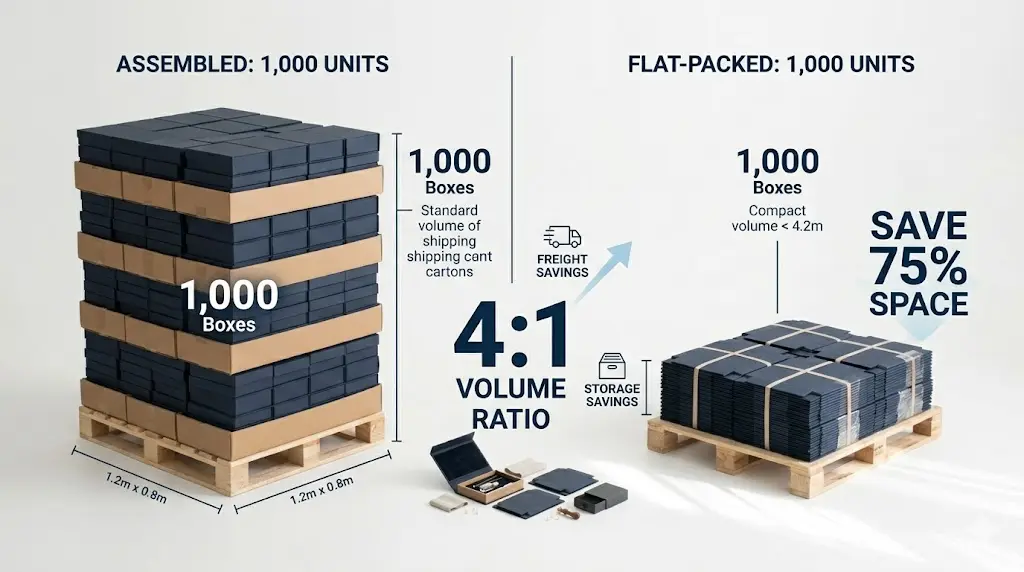
How Much Do Collapsible Rigid Boxes Actually Save on Freight and Storage?
The savings are real, but the exact figure depends on box dimensions and your specific freight arrangement. Here's a concrete example to make the math clear.
A standard rigid box measuring 25 × 20 × 10 cm has an assembled volume of 5,000 cm³. The same box in flat-pack form measures roughly 25 × 20 × 1.5 cm - a volume of approximately 750 cm³. That's about one-seventh the assembled volume, meaning a carton that holds six pre-assembled boxes can hold more than forty flat-packed units. On a full container shipment, that compression translates directly into fewer CBMs booked and lower freight cost per unit. For most standard box profiles, brands see shipping volume reductions in the range of 60–80% compared with pre-assembled equivalents.
The warehouse equation matters just as much for growing brands. Third-party logistics providers charge by cubic foot of storage. A pallet of 1,000 pre-assembled rigid boxes occupies four to six times the floor space of the same quantity in flat-pack format. For seasonal product lines - holiday gift sets, limited-edition launches, subscription box programs - that difference often determines whether a 3PL arrangement is economically viable during peak inventory weeks.
On assembly time: experienced packers typically assemble a collapsible rigid box in 15–30 seconds depending on format complexity. At any meaningful production volume, that labor cost is a fraction of the freight savings it enables.
Five Collapsible Rigid Box Formats - and When to Use Each
Not all collapsible rigid boxes are the same structure, and the format you choose affects both the unboxing experience and your per-unit manufacturing cost. The five most commonly ordered formats are:
- Magnetic book-style (clamshell): A hinged lid with embedded magnets, opening like a book. This is the most widely manufactured collapsible format and the most forgiving to source with consistent quality. Best for cosmetics, PR kits, apparel, and anything where a dramatic one-handed reveal matters. The collapsible rigid box with magnetic closure is the right starting point if you're ordering samples for the first time - it gives you a reliable quality baseline before committing to more complex formats.
- Magnetic lift-off lid: A flat lid that lifts cleanly from the base. More ceremonial than the book-style; the reveal is slower and more deliberate. Well suited to fragrance, skincare bundles, and curated gift sets.
- Two-piece top-and-base: A classic lidded box without magnets, held by friction and panel depth. The most cost-efficient structure in the collapsible category, appropriate for mid-range gift and apparel packaging at volume.
- Drawer-style: An inner tray that slides out from a sleeve. Creates a layered reveal effect suited to jewelry, watches, sunglasses, and flat accessories where the product benefits from a theatrical presentation.
- Shoulder-neck: A structural shoulder ring keeps the lid precisely aligned on the base, preventing the tilt that can occur with tall, narrow boxes. The right choice for candles, bottles, and anything with a height-to-diameter ratio that needs axis control.
If you need insert depth flexibility across multiple SKUs - for example, if the same box needs to accommodate products of different heights across your line - a fold-flat rigid box with adjustable fitment allows you to standardize the outer structure while varying the interior configuration per SKU.

Customization Variables and What Actually Drives Per-Unit Cost
Most manufacturers can adjust size, structure, chipboard weight, exterior wrap paper (matte, gloss, textured, kraft), interior lining (EVA foam, velvet, paper pulp, thermoformed tray), print method, and surface finish. In practice, the variables that move cost most are:
- Print and finish complexity: Multi-color foil stamping, spot UV, and embossing each require dedicated tooling. A single-color matte wrap with debossed logo costs considerably less per unit than a multi-foil CMYK build.
- Interior insert type: A flat velvet-wrapped tray die-cut to your product shape is substantially cheaper to tool than a custom thermoformed plastic insert. For fragile or shaped products, the insert is where the engineering investment pays off most.
- Chipboard thickness relative to box volume: A large box with 2,000 gsm board uses more material and takes longer to hand-assemble than a smaller box at 1,400 gsm. If you're working toward a per-unit cost target, this is worth discussing explicitly with your manufacturer.
One decision worth making early in the spec process: whether the interior insert should be fixed or removable. Fixed inserts are bonded during manufacturing, look precise, and add structural stability - but they lock in your product dimensions permanently. Removable inserts offer flexibility for brands with variable product sizing, or for products where the box has a life beyond the purchase (a customer using a rigid box for storage is a form of long-term brand presence that doesn't cost anything after the sale). If you're not yet certain what dimensions your insert needs to be, reviewing standard gift box size configurations and insert ranges before your first spec conversation with a factory will save you time.
Price varies significantly by structure complexity, quantity, and finish spec. Requesting a formal quotation at your target MOQ - alongside a physical sample - is the only reliable way to get an accurate per-unit figure. Factories that quote without reviewing your spec should be treated with skepticism.
How to Evaluate a Manufacturer Before Committing to a Production Run
Choosing a packaging manufacturer is a higher-stakes decision than it appears. A poor production run on rigid boxes can delay a product launch, create 3PL fulfillment problems, or - in the worst case - produce unboxing experiences that actively undermine a brand's positioning. The following checks are worth running before you commit to full production.
Sample policy: Any reputable manufacturer should be willing to produce a physical sample run - typically 5–10 units - before full production. A factory that declines to run samples, or that charges unusually high sample fees relative to production pricing, is a meaningful red flag regardless of their quoted unit cost. Most factories producing custom rigid and folding packaging at scale treat sampling as a standard part of the sales process.
Structural quality checks on samples: When samples arrive, check that corners are square and hold their angle when light pressure is applied. Assemble and disassemble the box five to ten times and inspect whether the crease lines retain their shape and whether the magnetic closure (if applicable) continues to seat cleanly. Compression testing - placing a weighted object on a stacked column of boxes - tells you whether the board will hold up under warehouse pallet conditions.
Packaging transit testing: For any product with fragility risk, test the complete shipping unit - retail box, insert, and outer carton together - using drop and vibration protocols before a product launch. The International Safe Transit Association (ISTA) publishes testing procedures that are widely used across the logistics and retail packaging industries as a benchmark for pre-shipment validation.
Documentation and certifications: Ask whether the factory can supply FSC-certified wrap papers and what their standard chipboard sourcing is. Factories with documented supply chains will be able to answer these questions directly; those that can't should not be trusted to meet any sustainability claims you make on your packaging.

Which Industries Use Collapsible Rigid Boxes - and What Makes Them Viable for Each
Jewelry is the category where the format's economics are most obvious. A fine jewelry brand shipping from New York needs packaging that can withstand the emotional weight of the purchase moment - a hinged reveal, a velvet-lined tray, corners that feel precise in the hand. Those requirements point directly to a rigid box structure. Historically, the cost of importing pre-assembled rigid boxes from overseas manufacturers consumed a significant share of the packaging budget purely in freight. A brand importing 5,000 drawer-style rigid jewelry boxes in flat-pack format can ship the equivalent of three or four pre-assembled pallets in a single pallet footprint, which changes the arithmetic of the whole packaging program.
For cosmetics brands, the issue is less about any single shipment and more about SKU depth. A beauty brand managing fifteen to thirty packaging variants across skincare, fragrance, and gift sets would face a logistical nightmare importing each SKU in pre-assembled form - the storage alone, across a 3PL, would be prohibitive. Collapsible structures let custom cosmetic packaging be stocked at low cubic cost and pulled to order. The presentation on shelf or in a DTC shipment is identical to a pre-assembled equivalent.
Luxury food and confectionery brands often face the tightest import timelines of any category. A seasonal gifting program that misses a pre-holiday freight window has no recovery path. Flat-pack structures compress the logistics window - more units per container means a brand can book a later sailing and still receive stock in time. For gift hamper and confectionery programs, this import timing flexibility can be the deciding factor in whether a gifting line is operationally viable in a given market year. Browse custom gift box options to see what structural and finish combinations are available for this category.
DTC subscription brands face a different version of the same problem: they need packaging inventory sitting in a 3PL at low cost, ready to ship against a daily order stream. Pre-assembled rigid boxes make that model expensive at scale. Flat-pack changes the unit economics of the whole fulfillment operation. For brands entering the luxury retail space for the first time, the collapsible format is often the most practical entry point - it delivers the premium presentation expected at that price point without requiring the inventory commitment of pre-assembled stock.
Sustainability: What the Material Choices Actually Mean in Practice
Flat-pack shipping is itself a sustainability story, and it's one of the more defensible claims a brand can make in supply chain ESG reporting. Fewer cubic meters per container shipment means fewer sailings required to import the same unit volume, and proportionally lower freight emissions per box. That reduction is calculable and auditable - it's not greenwash.
Beyond the logistics efficiency, the material choices in the box itself matter. FSC-certified wrap papers are available from most manufacturers and don't meaningfully affect print quality or finish range. Soy-based inks are compatible with the CMYK offset processes used for most rigid box exteriors. Chipboard made from recycled fiber is structurally comparable to virgin board at medium to heavier thickness ranges (roughly 1,500 gsm and above); at lower thicknesses, recycled fiber board can exhibit slightly reduced stiffness, and this is worth confirming with your manufacturer for your specific box dimensions.
There is also a less obvious sustainability argument in the format itself: a well-made rigid box is a box that customers keep. Unlike folding cartons, which are typically discarded immediately, a collapsible rigid box with quality materials and construction tends to be repurposed - for storage, gifting, or display. That secondary lifecycle has real emissions value, and it also extends the brand's visual presence in the customer's physical environment long after the initial purchase.
Frequently Asked Questions
What is the typical minimum order quantity (MOQ) for custom collapsible rigid boxes?
Most factories can accommodate orders from 300 to 500 units for a standard magnetic book-style box without unusual finish complexity. More elaborate structures - boxes with custom thermoformed inserts, multi-color foil exteriors, or shoulder-neck alignment rings - may require higher minimums to cover tooling amortization. As a working rule, always request a physical sample run before committing to full production. Any factory unwilling to run samples is a risk, regardless of their pricing.
Are collapsible rigid boxes as structurally strong as pre-assembled set-up boxes?
Yes, when manufactured correctly. The key variable is the quality of the crease scoring and the corner anchor system, not the collapsible mechanism itself. Interior panel chipboard in the 1,200–2,000 gsm range - the same density used in traditional rigid set-up boxes - provides equivalent corner rigidity and compression resistance. The practical test: check that corners remain square after five to ten assembly and disassembly cycles, and test the box under stack load conditions that simulate pallet storage.
Can collapsible rigid boxes be used for heavy or fragile products like glass bottles?
Yes, but the box structure alone is not what protects a fragile product - the insert is. A well-fitted EVA foam insert or custom paper pulp tray provides the lateral suspension and shock absorption that glass and ceramics require. The rigid box walls support vertical load; the insert handles movement. Test the complete shipping unit - retail box plus outer carton - using a recognized drop protocol before launch rather than relying on visual inspection alone.
What lead times should I plan for?
Sampling generally takes 7–10 business days from approved artwork. Full production after sample sign-off typically runs 18–25 business days, depending on quantity, finish complexity, and factory capacity at the time of order. Sea freight transit from Shenzhen adds 18–35 days depending on destination port. Brands ordering for a peak season window should initiate production conversations at minimum 90 days in advance of their in-warehouse target date - and earlier if the box involves significant tooling or custom insert work.
Is hand assembly the only option, or can collapsible rigid boxes be used on automated packing lines?
Hand assembly is standard for this format, and that's partly a feature rather than a limitation. Premium packaging fulfillment environments typically operate hand-packing workflows by design - it allows QC inspection at the point of packing, which is harder to replicate on a fully automated line. If your operation requires automated-line compatibility at high throughput, a folding carton is likely the better structural choice for that workflow, though it comes with corresponding trade-offs in perceived quality and compression resistance.


