

Paperback printing runs roughly $1.50–$3.50 per unit at standard trade quantities, while hardcover lands between $5.00–$9.00 per unit for the same specs. That 2–4x cost gap is real - but it rarely tells the whole story. The format that earns you more isn't always the cheaper one to produce. Hardcovers command 40–60% higher retail prices, survive heavy handling for years, and signal premium value before a reader touches page one. Paperbacks move faster, ship cheaper, and reach the widest possible audience. Your choice depends on three things: who's buying, how the book will be used, and what margin structure serves your publishing goal. This guide breaks it all down.
What Actually Goes Into Each Format - and Why the Costs Differ
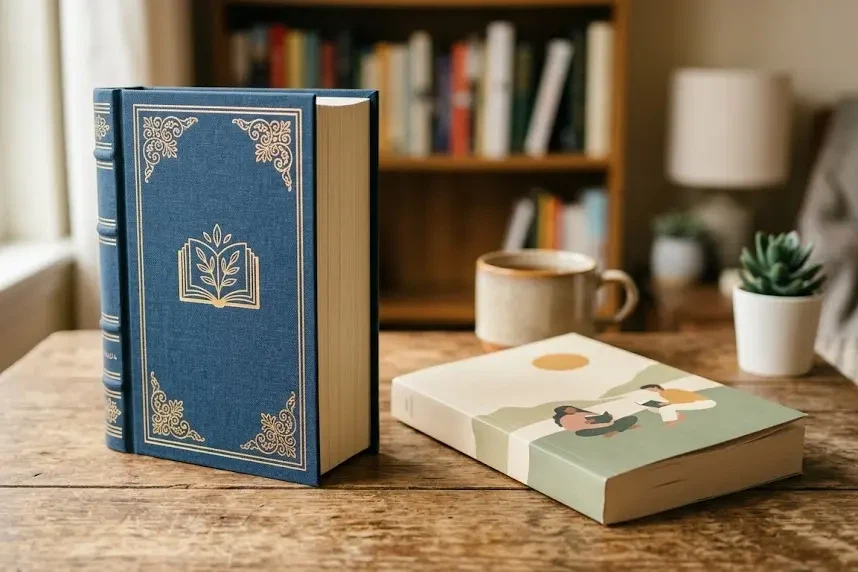
Hardcover books are built around a case - rigid binder's board cut to size, wrapped in printed paper, cloth, or specialty materials, then laminated and pressed. The board stock alone typically runs 80–98 point thickness, roughly 2–3mm of protective material that a paperback cover never uses. After the case is made, end sheets are glued to the interior, headbands are added at the spine for reinforcement, and the book block is inserted and adhered under controlled pressure. This case-making process is semi-automated even in high-volume facilities, which means more labor time per unit compared to paperback production.
Paperbacks, by contrast, use a single-layer flexible cover - usually 250–350 GSM coated stock laminated with matte or gloss film. Pages are perfect-bound: the spine is roughened, adhesive is applied, and the cover wraps around in one continuous pass through a binding line. It's faster, uses fewer materials, and requires less post-production cure time. That mechanical simplicity is exactly why the per-unit cost is lower.
Optional hardcover upgrades - foil stamping on the spine, debossed titles, decorative endpapers, ribbon bookmarks, or a printed dust jacket - each add incremental cost but also add the kind of physical detail that readers notice and remember. These aren't just aesthetic choices. They're market positioning decisions baked into the production spec.
For publishers and independent authors weighing their options, understanding professional book printing processes is the foundation for making the right format call. The production path you choose locks in your cost structure from the first print run forward.
Breaking Down the Numbers: Real Cost Ranges by Quantity
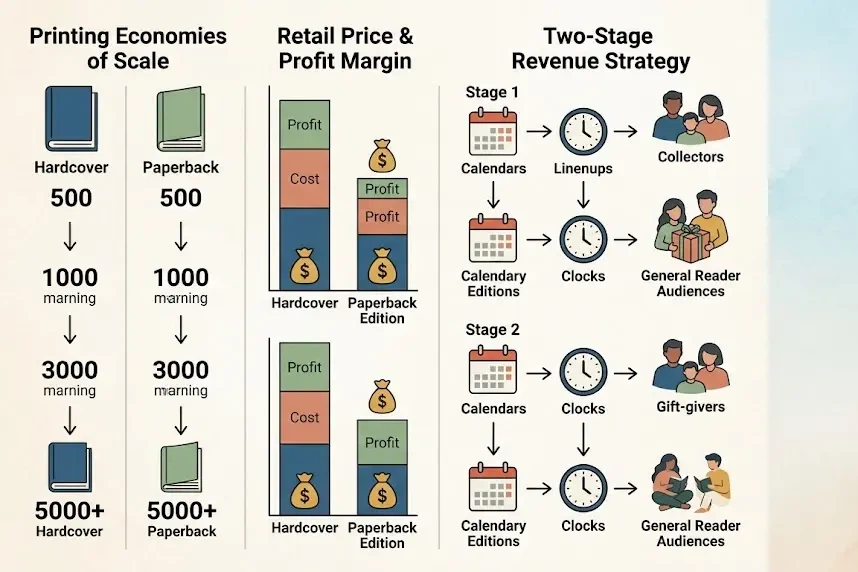
Print quantity is the single biggest variable in per-unit cost, regardless of format. Both hardcover and paperback follow steep economies of scale - the first 500 copies cost significantly more per unit than the next 2,500. Here's what to expect from a professional print manufacturer at standard trade size (6" x 9", 200 interior pages, full-color cover):
For paperback (perfect bound, matte laminated cover): 500 copies land around $2.50–$3.50 each. Push to 1,000 copies and that drops to $1.80–$2.50. At 3,000 copies you're looking at $1.20–$1.80 per book, and 5,000+ brings it down to $0.90–$1.40.
For hardcover (casebound, with dust jacket): 500 copies run $6.50–$9.00 each. At 1,000 copies, expect $5.00–$7.00. The 3,000-copy range brings it to $3.80–$5.50, and 5,000+ typically falls between $3.00–$4.50 per book.
The premium feels significant at low quantities. But here's what those numbers don't show: a hardcover edition priced at $34.99 retail vs. a paperback at $18.99 can generate comparable or better margin per unit, even after the higher production cost. Publishers that release hardcover first - capturing the collector and gift market - then follow with a paperback edition 6–12 months later are running a two-stage revenue strategy that squeezes value from both ends of the market.
Durability: What the Physical Difference Means Over Time
This is where hardcover books earn their premium in ways that go beyond appearance. The rigid case construction distributes stress across the spine when the book is opened, which is why a well-made hardcover can survive hundreds of reads without the spine cracking. The sewn or smyth-sewn book block common in quality hardcover production keeps pages from loosening even after years of use - a critical factor for reference books, religious texts, cookbooks, and any title that gets opened to the same pages repeatedly.
Paperbacks degrade differently. Perfect binding is strong enough for most casual reads, but repeated opening - especially when the book is forced fully flat - stresses the adhesive at the spine and eventually causes pages to pull away. Higher-quality paperbacks use PUR (polyurethane reactive) adhesive rather than standard hot-melt EVA, which dramatically improves flex resistance and extends the book's functional lifespan. When durability matters for a softcover run, specifying PUR binding is one of the most cost-effective upgrades available.
For applications where books see sustained institutional or professional use - textbook printing being the clearest example - durability isn't a nice-to-have. It's a procurement criterion. Schools and universities factor replacement rates into their total cost of ownership, and a hardcover or PUR-bound paperback that lasts five years has a fundamentally different cost profile than a standard paperback that needs replacing after two.

Market Fit: Matching Your Format to Your Reader
Genre shapes format expectations more than most authors realize. Fiction readers have been trained by decades of publishing convention to associate mass-market paperbacks with affordability and portability. They're not looking for a premium object - they want the story. That's why 70%+ of adult fiction sells in paperback. The format signals "this is meant to be read and passed along," which is exactly right for the audience.
Hardcover dominates in categories where the physical object carries meaning beyond the text. Art books, photography collections, cookbooks, first editions of literary fiction, business books by credentialed authors, gift-market titles - all of these reach audiences who expect a certain weight in their hands. The hardcover isn't incidental to the reading experience. It is part of the product.
Children's books occupy an interesting middle ground. Board books for toddlers are a category of their own, but picture books for ages 4–8 are almost universally published in hardcover for one practical reason: children are hard on books. The durability premium is a direct response to the use case. Children's book printing in hardcover also supports the gift market - parents and grandparents buying picture books as presents expect a hardcover product.
Self-published authors are frequently torn between formats, and the answer usually depends on where they're selling. Authors selling primarily through Amazon benefit from the platform's print-on-demand ecosystem, which favors paperback for unit economics. Authors selling at speaking engagements, conferences, or through their own channels - where they control the price and the customer relationship - often do better with a hardcover that justifies a $24.99–$34.99 price point and functions as a credibility marker.
Special Formats Worth Knowing
Not every book fits neatly into the hardcover-or-paperback binary. Some formats deserve specific mention because they come up repeatedly in publishing decisions:
Case-wrapped hardcover (also called printed board) skips the dust jacket entirely and prints directly onto the case material. It's cleaner, more modern-looking, and cheaper than a separate dust jacket - a popular choice for children's books and gift titles where the dust jacket would get lost anyway. For Bible printing and devotional books, case-wrapped construction in leather or bonded leather is essentially the industry standard.
French flap paperbacks - softcovers with extended cover flaps that fold inward - add a literary, upmarket feel to a paperback edition. They're common in independent publishing and literary fiction, providing a visual and tactile distinction without the full cost of hardcover production. They photograph well, which matters for social media marketing.
Lay-flat binding, whether spiral-bound or wire-O, solves a problem that neither traditional hardcover nor paperback addresses: books that need to stay completely flat when open. Workbooks, recipe books, planners, and technical manuals all benefit. It's not glamorous, but it's the right spec for the use case.

How to Make the Decision
There's a practical framework that cuts through most of the uncertainty. Start with your retail price and work backward. If the category's standard retail price for your genre and page count is $15.99, hardcover math almost certainly doesn't work - the production cost consumes your margin before you've paid for distribution. If the category supports $28.99 or higher, hardcover opens up and often makes more sense than a paperback fighting in a crowded low-price bracket.
Then ask where the book lives. A book that will be displayed on a shelf, given as a gift, or used for reference over years belongs in hardcover. A book that will be carried in a bag, read once, or distributed at scale belongs in paperback. A book that might do both - which is true for many successful titles - warrants a two-format strategy, with hardcover launched first at premium price and paperback following to capture the broader market.
Print quantity matters too, especially for first-time publishers. Digital offset printing has made short runs economically viable, but the per-unit cost gap between 500 and 3,000 copies remains significant. If your initial print budget is tight, starting with 1,000 paperback copies and using sales data to inform a subsequent hardcover run is a lower-risk path than a large hardcover first print that ties up capital before you've validated demand.
For publishers weighing notebook and journal printing alongside traditional book formats, the same logic applies: the format should serve the use case, not the other way around. A hardcover journal justifies a $22 retail price at a gift shop. A spiral-bound notebook at $9.99 moves volume in a school supply context. Both can be profitable - they're just different products for different markets.
Frequently Asked Questions
How much more does hardcover book printing cost compared to paperback?
At standard trade quantities (1,000–3,000 copies), hardcover printing typically costs 2.5–4x more per unit than an equivalent paperback. For a 200-page, 6"x9" book, paperback runs roughly $1.80–$2.50 per copy at 1,000 units; hardcover with a dust jacket runs $5.00–$7.00 per copy at the same quantity. The gap narrows at higher print quantities as both formats benefit from economies of scale.
Is hardcover worth the extra cost for self-published authors?
It depends entirely on your sales channel and retail price point. Authors selling through live events, professional speaking, or their own website - where they control pricing - often find hardcover generates better margin per unit despite the higher production cost. Authors primarily selling through Amazon print-on-demand are usually better served by paperback, where unit economics and platform algorithms favor the lower-priced format. Many successful self-published authors run both formats: hardcover for direct sales and gift buyers, paperback for broad retail distribution.
What is the most durable binding option for books that get heavy use?
Smyth-sewn hardcover binding is the most durable option for books that will be read repeatedly. For paperbacks, PUR (polyurethane reactive) adhesive binding significantly outperforms standard hot-melt EVA - it stays flexible rather than becoming brittle, and withstands far more open-close cycles before the spine shows stress. For textbooks, workbooks, and professional reference materials, specifying PUR binding on a paperback is one of the most cost-effective durability upgrades available.
Can I print both hardcover and paperback versions of the same book?
Yes, and many publishers do exactly this. The standard approach is to release the hardcover edition first at a premium price point to capture early buyers, gift purchasers, and collectors - typically 6 to 12 months before the paperback follows at a lower price for the broader market. Both editions share the same interior files; the primary variable is the cover spec and binding method. Running both formats also gives you retail pricing flexibility and the ability to serve different customer segments simultaneously.
What book types are best suited for hardcover vs paperback?
Hardcover is the right call for coffee table books, art and photography collections, cookbooks, children's picture books, gift editions, religious texts, first editions of literary fiction, and any title where the physical object has value beyond its content. Paperback suits mass-market fiction, workbooks, educational materials, training manuals, and any title where wide distribution, portability, and price accessibility are the primary goals.
Getting the format right from the start saves you from reprinting decisions that eat into your margin. Whether you're planning your first print run or evaluating a catalog of existing titles for new editions, the production spec you choose shapes the entire economics of the project. Xingwei's book printing services cover both hardcover and paperback production with low minimum order quantities and direct factory pricing - a practical option for publishers at every scale.


