

Unraveling the Mystery of Children's Book Printing Costs
For authors, illustrators, or self-publishers looking to bring a 32-page children's book to life, one of the most pressing questions is always about printing costs. A 32-page children's book, with its vibrant illustrations, durable paper, and kid-friendly design, involves more than just putting ink on paper-it requires careful consideration of printing technologies, paper selection, binding methods, and order quantities, all of which directly impact the final cost. In this blog, we'll not only break down the factors that determine the cost of printing a 32-page children's book but also (popularize) key printing technologies to help you make informed decisions. Whether you're a first-time publisher or a seasoned creator, this guide will combine authoritative printing knowledge with practical cost-saving tips, ensuring you understand every aspect of the process.
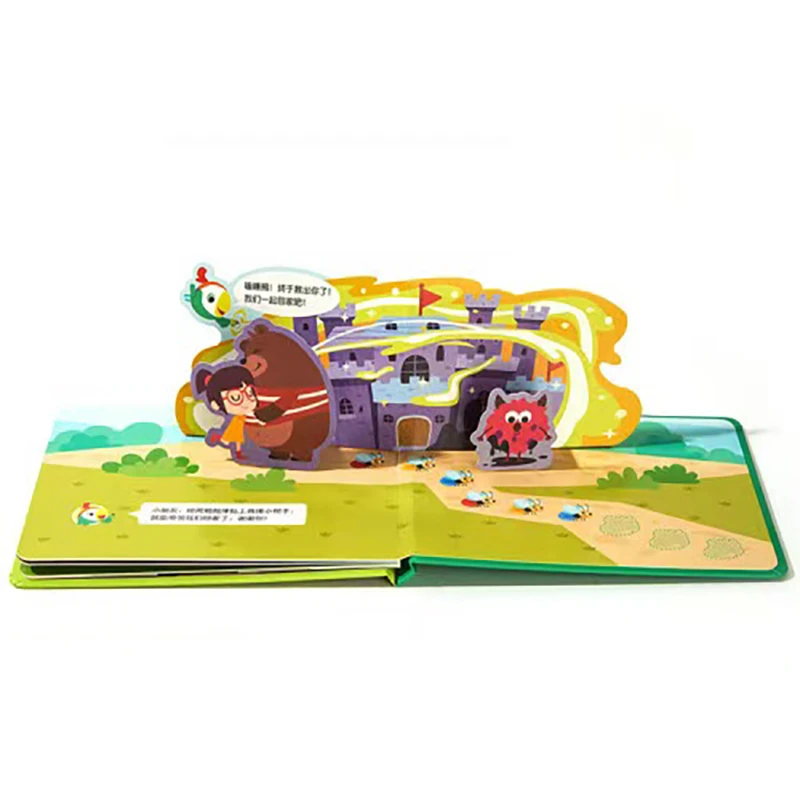
Part 1: Printing Technologies for 32-Page Children's Books – What You Need to Know
Before diving into costs, it's essential to understand the printing technologies commonly used for children's books. Each technology has its own advantages, limitations, and cost structures, making it crucial to choose the right one for your 32-page project.
1.1 Offset Lithography: The Go-To for High-Volume Children's Book Printing
Offset lithography (often called "offset printing") is the gold standard for high-volume printing of children's books-including 32-page titles. This technology works by transferring ink from a metal plate to a rubber blanket, then onto the paper. It excels at producing sharp, consistent colors, which is critical for children's books that rely on vivid illustrations to engage young readers.
Key benefits for 32-page children's books:
Cost-effectiveness at scale: While setup costs (for creating plates) are higher, the per-unit cost drops significantly when printing 500 copies or more. For a 32-page book, this makes offset printing ideal if you plan to distribute to bookstores, schools, or online retailers in large quantities.
Superior color accuracy: Offset printing uses the CMYK color model (Cyan, Magenta, Yellow, Key/Black) to replicate even the most detailed illustrations. This is especially important for children's books where colors need to be bright and true to the original artwork.
Compatibility with various paper types: Offset printing works well with thick, durable papers (such as 100# gloss or matte text) that are often used for children's books to withstand wear and tear from small hands.
1.2 Digital Printing: Perfect for Small-Batch 32-Page Children's Books
Digital printing is a game-changer for authors or publishers who need smaller quantities of a 32-page children's book-typically 1 to 500 copies. Unlike offset printing, it doesn't require metal plates; instead, it uses toner or inkjet technology to print directly onto paper from a digital file.
Why choose digital printing for your 32-page children's book?
Low setup costs: Since there are no plates to create, digital printing has minimal upfront expenses. This makes it ideal for test runs, limited editions, or self-publishers who want to avoid the risk of overprinting.
Quick turnaround time: Digital printers can start producing books within hours of receiving your file, compared to offset printing, which may take days for plate setup. If you need your 32-page book ready for a local event or a small launch, digital printing is the way to go.
Variable data printing: While not always necessary for 32-page children's books, digital printing allows for easy customization-such as adding a child's name to the cover or inside pages. This can be a unique selling point for personalized children's books.
1.3 Key Printing Terminology to Understand
To communicate effectively with printers and avoid confusion, it's important to know these core printing terms:
Page count: A 32-page children's book is typically a "signature"-a group of pages folded together. For offset printing, signatures are often in multiples of 8 (e.g., 8, 16, 32 pages) to optimize binding efficiency.
Paper weight and finish: Measured in pounds (#) or grams per square meter (gsm), paper weight affects durability and cost. For 32-page children's books, common choices include 80# or 100# gloss text (for vibrant illustrations) or 70# matte text (for easier reading under bright lights).
Binding method: For 32-page books, saddle stitching (stapling along the spine) is the most common and cost-effective option. It works well for thinner books (up to 64 pages) and is easy for kids to flip through. For a more premium look, perfect binding (gluing pages into a cover) may be used, but it adds to the cost.
Print run: The total number of copies you order. As mentioned earlier, print run size directly impacts per-unit cost-larger runs mean lower costs per book.
Part 2: Breaking Down the Cost of Printing a 32-Page Children's Book
Now that you understand the key printing technologies, let's dive into the actual costs. The total cost of printing a 32-page children's book can range from \(2 to \)15 per copy, depending on four main factors: printing technology, paper selection, binding method, and order quantity. Below is a detailed breakdown to help you estimate your project's cost.
2.1 Cost by Printing Technology
As noted earlier, offset and digital printing have very different cost structures for 32-page children's books.
Digital Printing Costs (1–500 Copies)
Setup cost: \(0–\)50 (most digital printers waive setup fees for standard files).
Per-unit cost:
1–50 copies: \(8–\)15 per book (higher because fixed costs are spread over fewer units).
51–200 copies: \(5–\)8 per book (costs drop as volume increases).
201–500 copies: \(3–\)5 per book (the most cost-effective range for digital printing).
Example: If you print 100 copies of a 32-page children's book using digital printing with 100# gloss text paper and saddle stitching, the total cost would be approximately \(500–\)800 (or \(5–\)8 per copy).
Offset Printing Costs (500+ Copies)
Setup cost: \(150–\)300 (for creating CMYK plates and adjusting the press).
Per-unit cost:
500–1,000 copies: \(2–\)3 per book (setup costs are spread over more units, lowering per-copy prices).
1,001–5,000 copies: \(1.50–\)2 per book (ideal for large-scale distribution to bookstores or schools).
5,000+ copies: \(1–\)1.50 per book (best for bestselling titles or books with national distribution).
Example: Printing 1,000 copies of a 32-page children's book via offset printing (100# gloss text, saddle stitching) would cost roughly \(350–\)600 total (setup cost + per-unit cost), or \(0.35–\)0.60 per copy-far cheaper than digital printing for large runs.
2.2 How Paper Selection Impacts Cost
The paper you choose for your 32-page children's book affects both cost and durability. Here are common paper options and their price differences:
70# matte text: The most affordable option (\(0.05–\)0.10 per page). It has a non-glossy finish that reduces glare, making it easy for kids to read. However, it's thinner and may not hold up to frequent use.
80# gloss text: A mid-range choice (\(0.10–\)0.15 per page). The glossy finish makes illustrations pop, and it's more durable than matte text. This is the most popular paper for 32-page children's books.
100# gloss cover + 80# gloss text: A premium option (\(0.20–\)0.30 per page). The thick gloss cover protects the book, while the interior text paper keeps the book lightweight. This is a good choice if you want a high-quality look (e.g., for gift books or premium editions).
For a 32-page book, the paper cost per copy can range from \(1.60 (70# matte text)** to **\)9.60 (100# gloss cover + 80# gloss text). Keep in mind that offset printing often offers lower paper costs per unit because printers can buy paper in bulk.
2.3 Binding Costs for 32-Page Children's Books
Binding is a small but important part of the total cost. For 32-page books, the two main options are:
Saddle stitching: The cheapest binding method (\(0.10–\)0.20 per book). It uses staples along the spine and is ideal for thin books (up to 64 pages). Most 32-page children's books use saddle stitching because it's affordable and easy for kids to flip pages.
Perfect binding: A more expensive option (\(0.50–\)1 per book). Pages are glued into a flexible cover, giving the book a "paperback" look. While perfect binding is more durable than saddle stitching, it's rarely used for 32-page books because the spine is too thin to hold the glue effectively.
2.4 Additional Costs to Consider
When calculating the total cost of printing your 32-page children's book, don't forget these extra expenses:
File preparation: If your book file (e.g., PDF) isn't formatted correctly for printing (e.g., missing bleed lines, incorrect color mode), printers may charge \(50–\)150 to fix it. To avoid this, ensure your file follows the printer's guidelines (most provide templates for 32-page books).
Shipping and handling: Depending on the printer's location and your order size, shipping can cost \(50–\)200. For large offset runs (1,000+ copies), some printers offer free shipping or discounted rates.
Proof copies: Before printing the full run, it's wise to order a proof copy (\(10–\)30) to check for errors in color, text, or binding. This small cost can save you from reprinting hundreds of faulty books.
Part 3: Practical Tips to Save Money on 32-Page Children's Book Printing
Printing a children's book doesn't have to break the bank. Here are authoritative, cost-saving tips based on industry best practices:
3.1 Choose the Right Printing Technology for Your Needs
The biggest cost saver is matching your print run to the right technology. If you need fewer than 500 copies, digital printing is cheaper (no setup fees). If you need 500+ copies, offset printing will give you a lower per-unit cost. For example, printing 300 copies via digital costs ~\(1,500, while 500 copies via offset costs ~\)800-so if you can commit to a larger run, you'll save money in the long run.
3.2 Optimize Your Page Count and Paper
Since 32 pages is already a standard signature size (ideal for offset printing), avoid adding extra pages (e.g., 33 pages) as this will require an additional signature and increase costs. For paper, choose a mid-range option (80# gloss text) instead of premium paper unless it's critical to your book's design. Most parents and kids won't notice the difference between 80# and 100# paper, but you'll notice the cost savings.
3.3 Negotiate with Printers
Don't be afraid to ask for discounts-especially if you're a repeat customer or have a large order. Many printers offer:
Volume discounts: For orders over 1,000 copies, you may get an extra 10–15% off the per-unit cost.
Bundle deals: If you need additional services (e.g., cover design, file preparation), ask to bundle them with printing for a lower total price.
Off-season discounts: Printers are often less busy in January–February or July–August, so you may get lower rates if you print during these times.
3.4 Order Proof Copies to Avoid Costly Mistakes
A \(20 proof copy can save you from spending \)1,000 on a faulty print run. Check the proof for:
Color accuracy: Ensure illustrations match your original artwork (offset printing should be 95%+ accurate).
Text errors: Look for typos, missing words, or misaligned text.
Binding quality: Make sure pages are stapled securely (for saddle stitching) and there are no loose pages.
Part 4: Final Cost Estimate for a 32-Page Children's Book
To summarize, here's a final cost estimate for different scenarios, based on industry averages:
|
Scenario |
Printing Technology |
Print Run |
Paper Type |
Binding |
Total Cost |
Cost Per Copy |
|
Small test run |
Digital |
50 copies |
80# gloss text |
Saddle stitching |
\(350–\)450 |
\(7–\)9 |
|
Self-publishing launch |
Digital |
200 copies |
80# gloss text |
Saddle stitching |
\(900–\)1,200 |
\(4.50–\)6 |
|
Local bookstore distribution |
Offset |
500 copies |
80# gloss text |
Saddle stitching |
\(700–\)900 |
\(1.40–\)1.80 |
|
National distribution |
Offset |
2,000 copies |
80# gloss text + 100# gloss cover |
Saddle stitching |
\(1,800–\)2,400 |
\(0.90–\)1.20 |

Making Informed Decisions for Your 32-Page Children's Book
Printing a 32-page children's book is a balance of quality, cost, and practicality. By understanding printing technologies (offset vs. digital), key printing terms, and the factors that impact cost (paper, binding, order quantity), you can make decisions that align with your budget and goals. Whether you're printing 50 copies for family and friends or 2,000 copies for nationwide distribution, the key is to choose the right printer-one that offers transparent pricing, high-quality work, and expertise in children's book printing.
Remember: The cheapest option isn't always the best. A well-printed 32-page children's book-with bright illustrations and durable paper-will engage young readers and stand the test of time. By using this guide, you'll be able to print a book that both you and your audience will love, without overspending.


