

That instinct is worth following - but only if you know what you're actually looking at. The words "first edition" printed in a book don't tell you nearly as much as most people assume. What matters is whether you're holding the first printing of the first edition, and that requires a closer look at the evidence on the copyright page.
This guide covers the full identification process: how to read a number line, what different publishers actually do (they don't all follow the same rules), how book age changes the approach entirely, what traps to watch for, and how to put a rough value on what you've found. Whether you've inherited a library or you're just curious about a book on your shelf, these are the steps that actually work.
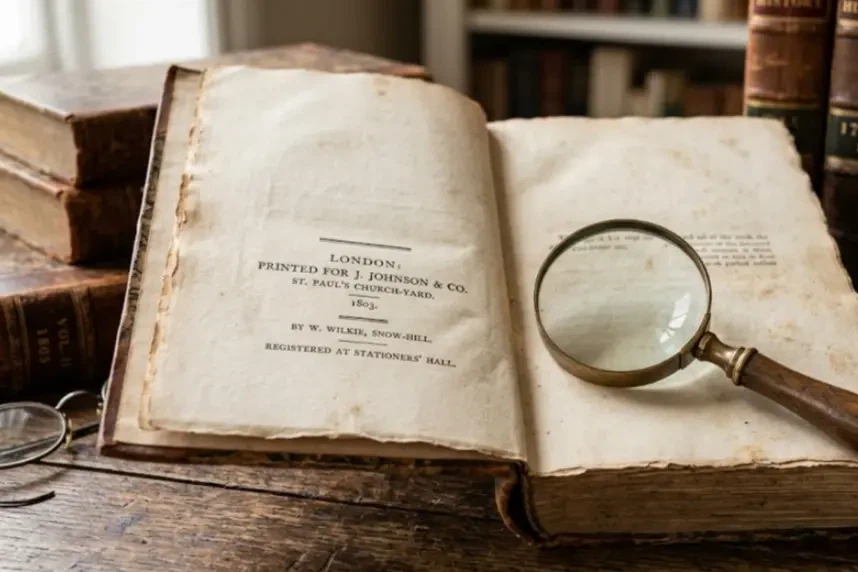
What "First Edition" Actually Means - and Why It's Confusing
The Publisher's Definition vs. the Collector's Definition
Publishers use "first edition" to describe all copies produced from the original typesetting - everything printed before the text is significantly revised. Under that definition, a book reprinted eight times without textual changes might still carry the "first edition" label on every copy.
Collectors mean something more specific. To a book collector, a true first edition means the first edition, first printing - the initial batch of copies produced when the book first went to press. That's the version with real collector value, and it's what the rest of this guide will help you identify.
Key Terms Worth Knowing
Before checking a single copyright page, it's worth getting these terms straight. Confusing them is the most common source of mistakes - and costly ones if you're buying or selling.
| Term | What It Means | Does It Count as a True First? |
|---|---|---|
| First Edition, First Printing | The original commercial release, earliest batch | Yes - the most valuable |
| First Printing, Second Printing… | Subsequent print runs within the same edition | Second printing onward: no |
| First State | Copy printed before a mid-run correction was made | Yes - often the rarest of all |
| Book Club Edition (BCE) | Version produced for book clubs, not general retail | No |
| Advanced Reading Copy (ARC) | Pre-publication copy sent to reviewers and booksellers | No |
| Limited Edition | Small, restricted print run, often signed | Sometimes - depends on timing |
| First Trade Edition | First version sold to the general public | Yes, if simultaneous with original release |
| Impression | Another word for printing | Same rules as "printing" |
A note on first state: sometimes during the printing of a first edition, the publisher or printer catches an error and corrects it mid-run. Copies produced before the fix are "first state." Both states belong to the same first printing, but first-state copies are rarer - and often more sought after by serious collectors.
How to Tell If a Book Is a First Edition: Step by Step
This process applies to most books published after World War II, when the number line system became standard. If your book is older, jump to the next section - the rules are different.
Step 1 - Find the Copyright Page
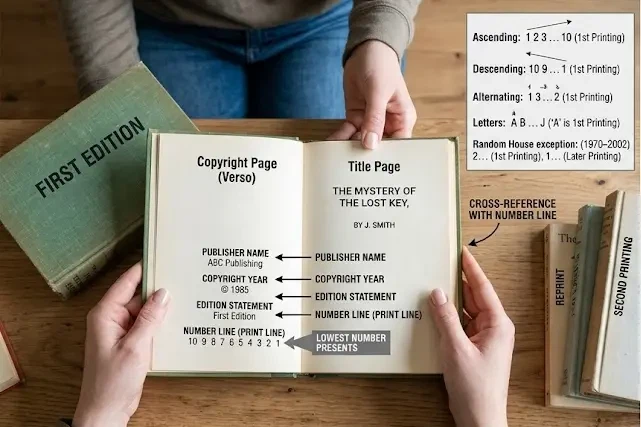
Open the book to the title page, then flip it over. The reverse side is the copyright page (also called the verso). This is where publishers record the information you need: publisher name, copyright year, any edition statement, and the number line.
If that page is blank or sparse, check the first few interior pages. Some older publishers placed this information elsewhere, and a small number of books - particularly very old ones - have no copyright page in the modern sense at all.
Step 2 - Read the Number Line
The number line (also called the print line or printer's key) is a row of numbers on the copyright page. It's the most reliable single indicator of which printing you're holding.
The rule is simple: the lowest number present tells you the printing. If "1" appears anywhere in the sequence, you have a first printing.
A common scenario: you pick up a novel at an estate sale with "First Edition" printed on the copyright page. You glance at the number line and see 10 9 8 7 6 5 4 3 2. The "1" is gone - meaning this is actually a second printing, not the first. The "First Edition" label stayed, but the number line tells the real story.
Number lines come in several formats:
- Ascending: 1 2 3 4 5 6 7 8 9 10
- Descending: 10 9 8 7 6 5 4 3 2 1
- Alternating (to keep the line centered as numbers are removed): 1 3 5 7 9 10 8 6 4 2
Some publishers use letters instead of numbers: A B C D E F G H I J. In that case, "A" means first printing, "B" means second, and so on.
For a deeper look at how to tell if a book is a first printing using these sequences, the patterns above cover most situations you'll encounter in modern books.
Important exception - Random House (1970–2002): During these years, Random House began their number lines with "2" on first printings, not "1." A sequence starting with "2" was their first printing. A "1" in the line during this period indicated a later printing. It's one of the most reliably misread number lines in book collecting, and it catches experienced buyers too.
For more on how to tell what printing a book is when the number line looks unusual, publisher-specific guides are your best resource.
Step 3 - Look for an Explicit Statement
Some publishers print the words "First Edition," "First Printing," or "First Published [year]" directly on the copyright page. Booksellers call this a "first edition stated," and it's a useful starting point.
But it can't be your only check. Some publishers left the "First Edition" statement in place across multiple printings - meaning the label persisted even as the book went through its second, third, and fourth runs. Always cross-reference with the number line when both are present.
If the copyright page says "First Edition" and the number line includes "1," you're in solid territory. If the statement is there but the number line starts at "3," trust the number line.
Step 4 - Verify the Publisher and Copyright Date
Two quick checks that often get skipped:
Copyright date: The copyright year should match the year the book was first published. If a book was originally released in 1968 and your copy shows © 1968, that's consistent with a first edition. A later copyright year typically signals a revised or new edition.
Publisher name: Compare the publisher listed on the copyright page with the name on the spine and title page. A mismatch - where the spine says one publisher and the copyright page says another - is a strong indicator that you're holding a reprint from a different house, not the original first edition.
To verify original publication details, WorldCat is a free and reliable resource. Search by title and author to find original publication records, including publisher and year.
For more on how to tell when a book was printed from its copyright information, cross-checking WorldCat against what's on your copyright page usually settles the question quickly.
When the Copyright Page Gives You Nothing to Work With
Not every book cooperates. If you're looking at a copyright page with no number line, no edition statement, and a date that doesn't clearly match what you know about the book's publication history, here's what to do:
- Search the title on WorldCat to confirm the original publisher and publication year
- Check FEdPo.com - a searchable database of modern first edition identification criteria, including documented points of issue for specific titles
- Look for physical characteristics: binding style, paper quality, and dust jacket details that match documented first printing descriptions
- For books of potential value, consult a dealer who is a member of the Antiquarian Booksellers' Association of America (ABAA)
For additional guidance on how to determine when a book was printed when the copyright page is ambiguous, physical and historical evidence often fills the gap that the page itself leaves open.
Step 5 - Check for Points of Issue
Points of issue are specific physical details - a printing error, a particular binding feature, a unique typographical quirk - that are unique to one printing of a book. They become important when the copyright page evidence is ambiguous or when a book is valuable enough that verification matters.
For example, a well-documented first edition might have a specific word misspelled on a particular page, corrected in the second printing. If your copy has that error, it's a strong confirmation of a first printing. Points of issue are documented by collectors and scholars, not something you'll find on your own without research.
Starting points for researching points of issue:
- FEdPo.com - searchable database of modern first edition criteria
- AbeBooks collecting guides - publisher and author-specific notes
- Author bibliographies - for significant authors, dedicated bibliographies document every known edition with identifying features
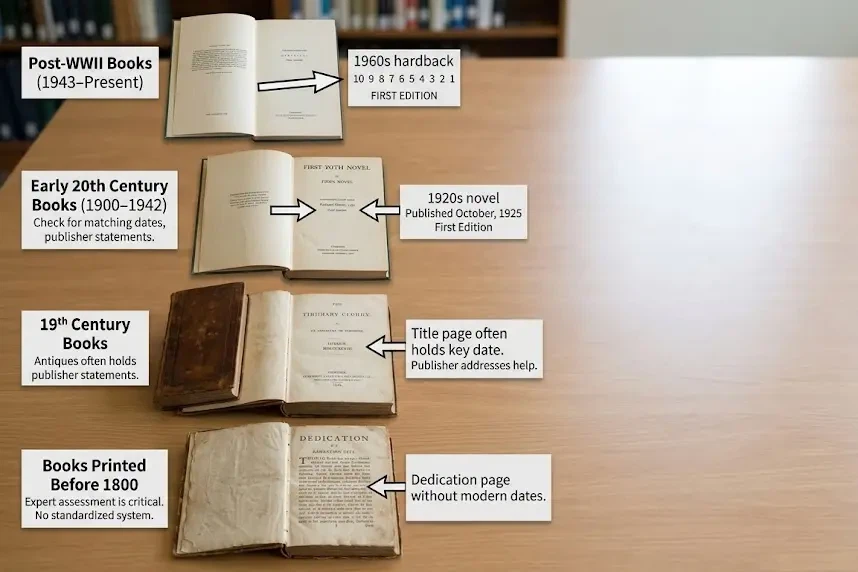
Identifying First Editions by Book Era
The five-step process above works well for books published after World War II. For older books, the number line didn't exist yet, and the rules change considerably depending on the era.
Post-WWII Books (1943–Present)
Use the full five-step process. The number line is your primary tool, supported by publisher statements and points of issue where needed.
Early 20th Century Books (1900–1942)
The number line system wasn't yet in wide use. For books from this period, look for:
- An explicit "First Edition" or "First Printing" statement on the copyright page
- A copyright date that matches the original publication year
- Physical characteristics: binding material, typeface style, and paper quality consistent with the period
When the copyright page is ambiguous, publisher archives and auction house records are useful references. Major auction houses maintain searchable records of first editions they've handled, which can help you confirm what a genuine first printing looks like for a specific title.
19th Century Books
Books from the 1800s predate the copyright page as we know it. For these, the focus shifts to:
- The title page, which often carried the publication date
- The publisher's name and address - publishers moved and merged frequently, and a specific address can help date a copy
- Physical characteristics: type of paper, binding cloth or boards, and printing method
One thing to know: "new edition" and "corrected edition" were common labels in the 19th century, and neither necessarily means the book was significantly revised. These labels alone don't disqualify a copy from being an important early printing. For well-documented authors from this period, dedicated bibliographies are indispensable - they record the specific binding colors, advertisement pages, and other physical features that distinguish one printing from another.
Books Printed Before 1800
Identifying first editions in books printed before 1800 is genuinely specialized work. There was no standardized system for marking editions, and much of the identification depends on historical records, paper analysis, typeface identification, and provenance documentation.
For books in this category, professional assessment is the appropriate route. University special collections librarians, antiquarian book dealers, and established auction houses can provide informed opinions. Attempting to self-identify a pre-1800 first edition without expert guidance is likely to produce errors in either direction.
How to Identify a First Edition by Publisher: A Quick-Reference Guide
Why Publisher Rules Matter
There is no universal standard for how publishers mark their first editions. Each house develops its own conventions, and those conventions change over time. The Random House example - where "2" meant first printing for three decades - is the most famous case, but it's far from the only one. Knowing your publisher's specific rules can prevent a misread that costs real money.
Publisher First Edition Identification: Quick Reference
This table covers general patterns for major publishers. For any specific title, cross-reference with a dedicated bibliography or database - individual books sometimes deviate from house style.
| Publisher | How First Editions Are Marked | Notes |
|---|---|---|
| Random House | Number line starting with "2" (1970–2002); "First Edition" stated | "1" in line during this era = later printing. After 2002, standard "1" format resumed |
| Scribner | Letter "A" alone on copyright page | No number line; A = first printing |
| Doubleday | "First Edition" explicitly stated | Generally no number line for older titles |
| Penguin / Viking | "First published [year]" with no reprint history listed | If reprints are listed below, it is not a first |
| HarperCollins | "First Edition" + number line including "1" | Standard format |
| Little, Brown | Number line including "1" | Standard format |
| Simon & Schuster | Number line including "1" | Standard format |
| Knopf | "First Edition" stated + number line | Both usually present |
| Houghton Mifflin | Number line including "1" | Standard format |
| Farrar, Straus and Giroux | "First edition" stated | May or may not include number line |
For publishers not listed here, AbeBooks' first edition collecting guide covers a broader range of houses and is regularly updated.
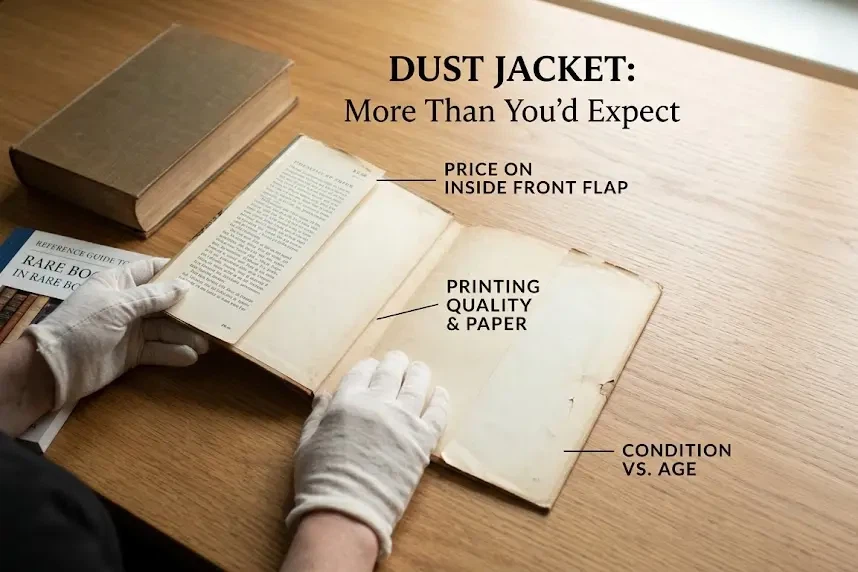
Does the Dust Jacket Matter? More Than You'd Expect
Most people focus entirely on the book block when checking for a first edition. The dust jacket - the paper wrapper around the cover - deserves equal attention, and for many 20th-century books, it deserves more.
Dust jackets were designed to be discarded. Libraries removed them. Readers threw them away. Bookshops stripped them for display. Original dust jackets from early printings survived in far smaller numbers than the books themselves, which makes them genuinely scarce - and that scarcity drives value.
For many collectible titles, a first printing with its original dust jacket commands a price several times higher than the same printing without one. The gap isn't always dramatic, but for highly sought-after books, it can be enormous.
How to tell if a dust jacket is original:
- Price on the inside front flap: Original dust jackets from the first printing typically show the original retail price. A jacket with the price clipped or covered warrants closer inspection - price-clipping was common, but it does reduce value.
- Printing quality and paper: Facsimile dust jackets (reproductions made to replace lost originals) are widely available for popular titles. They're produced with modern printing technology, which tends to create slightly different color depth and paper texture than period originals. Comparing the jacket paper to reference copies at an auction house or in a catalogue can reveal the difference.
- Design consistency: The jacket's typography, color palette, and layout should be consistent with the book's publication era. Anachronisms - fonts or design conventions that didn't exist when the book was published - suggest a later reproduction.
- Condition vs. age: A jacket in suspiciously pristine condition on an otherwise well-aged book may be a facsimile or replacement.
When buying from a reputable dealer or auction house, the jacket's status - original, price-clipped, or facsimile - will typically be disclosed. If it isn't mentioned, ask before committing to a price.
If you're planning to have a dust jacket printed or replaced for archival or display purposes, dust jacket printing services can produce high-quality reproductions - though for collector purposes, a facsimile always carries less value than an original.
Common First Edition Traps - and How to Spot Them
Even careful buyers encounter these. Knowing what to look for is more useful than being told to "be careful."
Book Club Editions (BCEs) - The Most Common Trap
Here's a scenario that plays out constantly at estate sales and online auctions: someone lists what looks like a pristine first edition, complete with a dust jacket and a copyright page that says "First Edition." The price seems reasonable. The buyer snaps it up. Then they notice - too late - that it's a Book Club Edition.
BCEs were produced specifically for book clubs, distributed separately from the trade edition, and printed with lower-cost materials. They look nearly identical to first editions on the surface, which is exactly why they're so frequently mistaken for them.
How to identify a BCE:
- No price on the dust jacket flap - or the price has been removed. Trade editions carry the retail price; book clubs don't use it
- Slightly smaller trim size - BCEs are often a bit shorter and narrower than the trade edition
- Lower paper and binding quality - noticeable when compared side by side with a trade copy
- No ISBN or price on the copyright page - trade editions include these; many BCEs do not
- Blind stamp on back board - some book clubs used a small, unprinted indented stamp on the back cover as an identifier. Run your finger across the back cover near the bottom or corner
- "Book Club Edition" printed on copyright page - not always present, but worth checking
A BCE has essentially no collector value, even for highly sought-after titles. Always check before assuming a well-preserved copy is a first edition.
Reprint House Copies
Throughout the mid-20th century, reprint publishers - including Triangle Books, Grosset & Dunlap, and Garden City - purchased rights to popular titles and produced cheaper editions, sometimes using the original publisher's printing plates. The interior text is identical to the original, which makes these copies deceptive.
The giveaway is usually the publisher name: compare the publisher listed on the spine and title page against the copyright page. A mismatch is a strong signal that you're holding a reprint edition, not the original first.
"First Edition" Stated - But Not Really
Some publishers, particularly in earlier decades, printed "First Edition" on the copyright page and simply never updated it across subsequent printings. The statement stayed as the book went through its second, third, and fourth runs.
This is the clearest reason not to rely on the statement alone. When "First Edition" is stated but no number line is present, use the copyright date, publisher history, and points of issue to verify. When both a statement and a number line are present, the number line wins.
Later Printing with an Original Dust Jacket
This combination is more common than buyers expect: a later printing of the book inside a first-edition dust jacket. It happens because jackets were swapped between copies over the decades, and because some later printings were sold with surplus first-edition jackets when the original stock was available.
The book and jacket need to be evaluated separately. A later printing with a first-edition jacket has meaningful jacket value but reduced overall value compared to a copy where both the book and the jacket are from the first printing.
How Much Is a First Edition Book Worth?
This is the question underneath most first edition searches, and it deserves a direct answer - even if that answer is "it depends on several things that vary widely."
What Actually Drives Value
Rarity: How many copies were printed? A debut novel with a modest print run of a few thousand copies is inherently scarcer than a bestseller's first edition in the hundreds of thousands. Rarity matters more than age - a common book from 1890 is worth less than a genuinely rare book from 1990.
Condition: Book collectors use a standard grading scale:
- Fine (F): Essentially perfect, no defects visible
- Very Good (VG): Minor wear consistent with careful use, no significant flaws
- Good (G): Noticeable wear, complete and readable but clearly used
- Fair: Heavy wear, may have writing, damage, or missing elements
A Fine copy regularly sells for several times what the same title in Good condition commands. Condition is not negotiable in the collector market.
For more on the difference in quality between first and subsequent printings, condition grading and printing sequence are closely related factors that serious buyers evaluate together.
Dust jacket: As covered above, the original dust jacket often accounts for a significant portion of a first edition's total market value - sometimes the majority of it.
Signature: A signed first edition - particularly with a meaningful inscription, and particularly if the author is deceased - adds value. How much depends on the author's significance and how commonly they signed books during their lifetime.
Current demand: Collecting tastes shift. A title that was highly sought after a decade ago may be less in demand today. Market value reflects what buyers are actually willing to pay right now, not historical peaks.
Where to Check Current Market Value
Rather than cite specific prices (which change continuously), these are the most reliable places to research what a specific copy is worth today:
- AbeBooks (abebooks.com): Search for your exact edition and compare active listings. Filter by condition. These are asking prices - sellers can list at any price - so use them as a ceiling, not a confirmed value
- Biblio.com: Similar to AbeBooks; useful for comparing across multiple dealers
- Heritage Auctions (ha.com): Their archive of past auction results gives you real sold prices, which are more meaningful than asking prices
- Swann Galleries (swanngalleries.com): Specialist auction house for books and manuscripts with an excellent price archive for rare and antiquarian material
If you believe you have something genuinely valuable - a recognized title in exceptional condition with an original dust jacket - a professional appraisal from an ABAA member dealer is worth the time and cost. They can assess both authenticity and current market value with authority that no online comparison can match.
Useful Resources for First Edition Research
These are worth bookmarking if you're doing any serious first edition identification work:
- FEdPo.com - Searchable database of modern first edition identification criteria. Enter a title and find documented points of issue, publisher statements, and other identifiers. Particularly useful for 20th-century fiction.
- Biblio's book collecting guide - Well-organized reference covering number lines, publisher conventions, and collecting terminology.
- WorldCat (worldcat.org) - For verifying original publication details. Aggregates records from thousands of libraries worldwide and is particularly useful when the copyright page is ambiguous.
- Auction house archives - Christie's, Heritage Auctions, and Swann Galleries all maintain searchable records of past sales. These give you real sold prices, which are more informative than asking prices on dealer sites.
- Author bibliographies - For significant authors, dedicated bibliographies document every edition and printing, including points of issue. Often available through university libraries or specialist booksellers.
For those approaching book identification from the production side - wondering how print runs are planned, how binding affects perceived quality, or what distinguishes a carefully produced hardcover book printing from a lower-cost alternative - these questions have direct parallels in the collector world, where production quality is often a key identifier.
A broader overview of the book printing guide covering methods, binding, and paper can help clarify how printing decisions made at production time show up as identifiable physical characteristics decades later.
FAQ: First Edition Book Questions Answered
Is a first edition always the most valuable version of a book?
Not always. A first edition is typically the most valuable if it's also the first printing and in fine condition. However, some later editions carry value if they include new content, significant illustrations, or a meaningful author's introduction. Limited editions produced after the first trade edition can also be collectible. The benchmark is first edition, first printing, Fine condition, with original dust jacket - but it's a general rule, not a guarantee.
What's the difference between a first edition and a first printing?
A first edition can include multiple printings. The first printing is the initial batch of copies produced. Subsequent printings are made when demand exceeds the initial run - same text, same edition, new batch. For more on how to tell which printing a book is, the number line is almost always the definitive indicator for modern books. Collectors value first printings most highly because they represent the earliest production run.
Does a first edition need a dust jacket to be valuable?
No - but the jacket substantially affects value. A first edition without its original jacket is still a first edition. For some titles, the difference is modest. For others - particularly mid-20th-century novels where dust jackets were commonly discarded - a first edition with an intact original jacket can be worth many times more than the same book without one. Always evaluate the book and jacket separately.
What is a Book Club Edition and how do I spot one?
A Book Club Edition (BCE) is a version produced for distribution through book clubs, not retail channels. It has no meaningful collector value. Key identifiers: no price on the dust jacket flap, slightly smaller trim size than the trade edition, lower-quality paper and binding, and sometimes a blind stamp (an unstamped indent) on the back board. Some BCEs are labeled on the copyright page, but many are not.
Can I trust a book that says "First Edition" on the copyright page?
Use it as a starting point, not a conclusion. Some publishers left "First Edition" in place across multiple printings. Always cross-reference with the number line when present. If the number line's lowest number is "1," the statement is confirmed. If the lowest number is higher, the number line overrides the statement.
How do I find out if my old book is worth money?
Start by confirming it's a genuine first printing using the steps in this guide. Then assess condition honestly against the standard grading scale. Search AbeBooks and Biblio for comparable copies to see current asking prices. For real sold prices, check the archives at Heritage Auctions or Swann Galleries. For anything that appears to be genuinely rare or valuable, an appraisal from an ABAA member dealer provides professional verification that no online comparison can replace.
Where can I sell a first edition book?
Options depend on the book's value. For lower-value first editions, AbeBooks and eBay reach wide audiences of buyers. For more significant titles, specialist auction houses - Heritage Auctions, Swann Galleries, Christie's - typically achieve higher prices and attract buyers who understand the material. A rare book dealer can also make an outright purchase offer if you prefer a direct sale. Whichever route you choose, have a realistic sense of current market value before agreeing to any price.
The Short Version: What Actually Matters
Most first edition identification comes down to a few reliable checks done in the right order. Find the copyright page. Read the number line - the lowest number is the printing. Look for an explicit edition statement, but don't rely on it alone. Verify the publisher name and copyright date. For anything valuable, research points of issue and evaluate the dust jacket separately.
If the copyright page is missing, ambiguous, or from a publisher with unusual conventions, use FEdPo.com, WorldCat, and publisher-specific guides before drawing any conclusions. For books that appear to be genuinely significant - particularly anything pre-1900 or tied to a major author - professional assessment is worth the effort.
Knowing how to tell if a book is a first edition is a skill that pays off gradually. The first few times, you'll catch yourself double-checking every detail. After a while, the process becomes instinctive - and so does the ability to spot when something doesn't add up.
If you're approaching books from the production side - thinking about what goes into printing a book for the first time and how those early decisions shape how the book is later identified and valued - many of the physical characteristics that collectors look for have direct roots in how the original print run was produced.


