

Paper Weight Conversion: GSM to lbs for Printing and Packaging
Paper weight conversion can be confusing, especially when one supplier uses GSM and another customer specifies paper in pounds. If you are preparing a book, catalog, folding carton, rigid box, label, insert, or other printed product, understanding the difference between GSM and lbs can help you choose the right material and avoid costly misunderstandings.
This guide explains how to convert GSM to lbs and lbs to GSM, why text weight and cover weight paper use different formulas, and how to apply paper weight conversions to real printing and packaging projects.
Quick Answer: How to Convert GSM to lbs
GSM means grams per square meter. It is a metric measurement used to describe the weight of paper. Pounds, often written as lb or #, are commonly used in the United States and refer to the basis weight of a specific paper type.
Because text paper and cover paper are calculated from different base sizes, they require different conversion factors.
GSM to Text lb Formula
To convert GSM to text weight pounds:
Text lb = GSM × 0.676
Example:
120 gsm × 0.676 = about 81 lb text
This formula is commonly used for book pages, catalogs, brochures, manuals, and other text-weight printed materials.
GSM to Cover lb Formula
To convert GSM to cover weight pounds:
Cover lb = GSM × 0.369
Example:
300 gsm × 0.369 = about 111 lb cover
This formula is commonly used for covers, cards, postcards, folding cartons, inserts, and other heavier paper products.
GSM to lbs Conversion Chart
Use this chart as a quick reference for common paper weights. The values are rounded, so your printer may use the nearest available stock.
| GSM | Approx. Text lb | Approx. Cover lb |
|---|---|---|
| 80 gsm | 54 lb text | 30 lb cover |
| 90 gsm | 61 lb text | 33 lb cover |
| 100 gsm | 68 lb text | 37 lb cover |
| 105 gsm | 71 lb text | 39 lb cover |
| 120 gsm | 81 lb text | 44 lb cover |
| 128 gsm | 87 lb text | 47 lb cover |
| 140 gsm | 95 lb text | 52 lb cover |
| 157 gsm | 106 lb text | 58 lb cover |
| 160 gsm | 108 lb text | 59 lb cover |
| 180 gsm | 122 lb text | 66 lb cover |
| 200 gsm | 135 lb text | 74 lb cover |
| 250 gsm | 169 lb text | 92 lb cover |
| 300 gsm | 203 lb text | 111 lb cover |
| 350 gsm | 237 lb text | 129 lb cover |
For many printing projects, lighter GSM values are used for inside pages, while heavier GSM values are used for covers, cards, cartons, and packaging components.
lbs to GSM Conversion Chart
If your customer gives you a paper weight in pounds, use the correct paper type before converting. An 80 lb text stock and an 80 lb cover stock are not the same material.
| lb | Text Paper GSM | Cover Paper GSM |
|---|---|---|
| 60 lb | 89 gsm | 162 gsm |
| 70 lb | 104 gsm | 190 gsm |
| 80 lb | 118 gsm | 217 gsm |
| 90 lb | 133 gsm | 244 gsm |
| 100 lb | 148 gsm | 271 gsm |
| 110 lb | 163 gsm | 298 gsm |
| 120 lb | 178 gsm | 325 gsm |
| 130 lb | 192 gsm | 352 gsm |
To convert lbs to GSM:
Text GSM = Text lb × 1.48
Cover GSM = Cover lb × 2.708
Example:
80 lb text × 1.48 = 118 gsm
80 lb cover × 2.708 = 217 gsm
What Does GSM Mean in Paper Weight?
GSM stands for grams per square meter. It tells you how much one square meter of paper weighs.
Because GSM is based on a fixed area, it is easier to compare across different paper types. A higher GSM usually means the paper is heavier, but it does not always mean the paper will feel thicker or stiffer. Coating, fiber, caliper, stiffness, finish, and paper structure can also affect the final feel.
For international printing and packaging projects, GSM is often the most practical way to communicate paper weight because it gives both the buyer and the manufacturer a more consistent reference point.
What Does lb Mean in Paper Weight?
In paper specifications, lb refers to basis weight. It is the weight of 500 sheets of paper measured at a standard base size for that paper category.
The confusing part is that different paper types use different base sizes. Text paper, cover paper, bond paper, index paper, and other categories are not calculated from the same sheet size. This is why the same lb number can describe very different paper weights.
Why 80 lb Text Is Not the Same as 80 lb Cover
One of the most common mistakes is assuming that all 80 lb paper feels the same.
In reality:
80 lb text is commonly used for inside pages, catalogs, booklets, and brochures.
80 lb cover is much heavier and is commonly used for covers, cards, inserts, and packaging-related materials.
So when a customer says "80 lb paper," you should always ask: 80 lb text or 80 lb cover?
Without that detail, the paper specification is incomplete.
Text Weight vs Cover Weight Paper
Before using a paper weight conversion chart, identify whether the project needs text weight or cover weight paper.
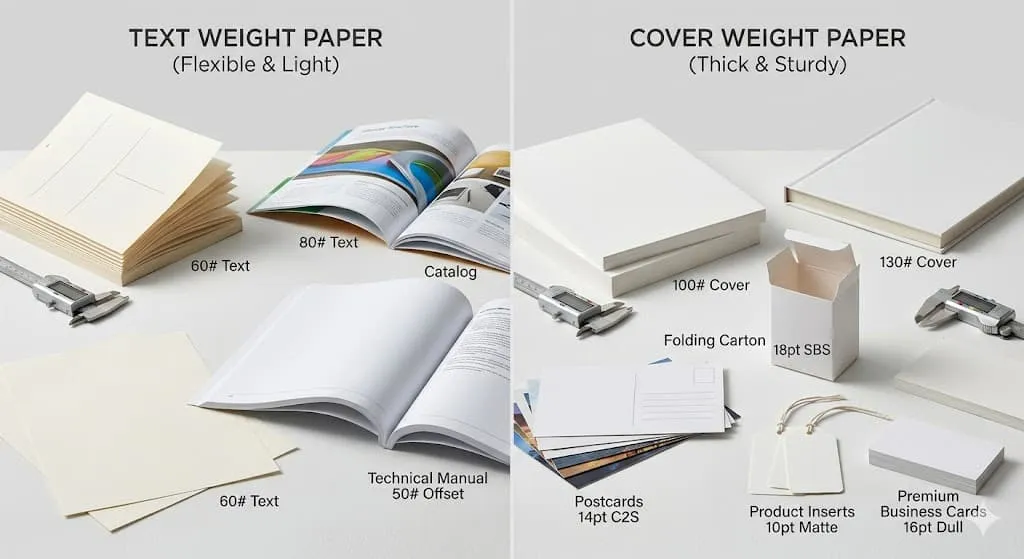
Text Weight Paper
Text weight paper is usually more flexible and easier to fold. It is often used for:
- Book interiors
- Catalog pages
- Brochures
- Manuals
- Flyers
- Inserts
- Instruction sheets
Common text paper weights include 80 gsm, 100 gsm, 120 gsm, 128 gsm, 140 gsm, and 157 gsm, depending on the product and desired feel.
Cover Weight Paper
Cover weight paper is heavier and more rigid. It is often used for:
- Book covers
- Catalog covers
- Postcards
- Greeting cards
- Folding cartons
- Retail packaging
- Hang tags
- Product inserts
- Premium cards
Common cover paper weights include 200 gsm, 250 gsm, 300 gsm, 350 gsm, and higher, depending on the packaging structure and durability requirements.
How to Choose Paper Weight for Your Printing or Packaging Project
A conversion chart helps you understand the numbers, but the best paper choice also depends on the product type, structure, printing method, finish, and end-use environment.
Books, Catalogs, and Manuals
For books and catalogs, the inside pages usually use text weight paper. Lighter papers can reduce shipping weight and make the book easier to handle, while heavier papers can improve opacity and give the product a more premium feel.
For covers, a heavier cover stock is usually preferred. A paperback book, catalog cover, or manual cover may also use lamination, varnish, or other surface finishing to improve durability.
When choosing paper for books, consider:
- Page count
- Binding method
- Ink coverage
- Opacity
- Spine thickness
- Target reading experience
- Shipping weight
Folding Cartons and Retail Packaging
Folding cartons often use heavier paperboard or card stock rather than ordinary text paper. GSM is helpful, but structure also matters. A small cosmetic box, food box, medicine box, or electronics carton may require different board strength even if the GSM looks similar.
When choosing paper for folding cartons, consider:
- Product weight
- Box size
- Shelf display requirements
- Die-cutting and creasing performance
- Surface finishing
- Whether the box needs inserts or windows
- Shipping and handling conditions
Rigid Boxes and Gift Packaging
Rigid boxes are different from folding cartons. They usually use thick greyboard or chipboard wrapped with printed paper. In this case, the outer printed paper GSM is only one part of the full structure.
For rigid boxes, you should also consider:
- Board thickness
- Wrapped paper type
- Box structure
- Magnet or drawer mechanism
- Insert material
- Edge wrapping quality
- Luxury finishing such as foil stamping, embossing, debossing, or spot UV
- If you only compare GSM, you may miss the most important structural details of the box.
Labels, Stickers, Inserts, and Cards
Labels, stickers, cards, and inserts often require more than a simple GSM decision. Adhesive type, release liner, coating, water resistance, folding performance, and surface finish can all affect performance.
For example, a product insert may need to fold cleanly, while a hang tag may need better stiffness. A sticker may need a specific adhesive or finish depending on whether it is used on glass, plastic, paper, or metal.
Common Mistakes When Converting GSM and lbs
Mistake 1: Treating lb as a Universal Measurement
A pound value is only useful when the paper type is clear. Always confirm whether the lb value refers to text, cover, bond, index, or another category.
Mistake 2: Assuming GSM Equals Thickness
GSM measures weight, not thickness. Two papers with the same GSM can feel different because of fiber, coating, density, texture, and finish.
Mistake 3: Ignoring the Final Product Structure
Packaging strength is not determined by GSM alone. Box style, paperboard grade, flute type, insert design, and finishing process can all influence the final performance.
Mistake 4: Choosing Paper Only by Price
Lower paper weight may reduce cost, but it can also affect durability, opacity, shelf appearance, and perceived quality. The best choice balances budget, function, and brand presentation.
Mistake 5: Not Confirming Samples
For important packaging and printing projects, a physical sample is often the safest way to confirm thickness, stiffness, color, finish, and hand feel before mass production.
When Should You Ask Your Printer for Advice?
You should ask your printer for advice when the paper weight affects structure, durability, appearance, or shipping performance.
This is especially important for:
- Custom rigid boxes
- Folding carton packaging
- Corrugated mailer boxes
- Hardcover books
- Softcover books
- Catalogs and manuals
- Premium product inserts
- Labels and stickers
- Gift sets and promotional kits
To get a more accurate recommendation, provide your printer with:
- Product type
- Size
- Quantity
- Target market
- Product weight
- Desired paper feel
- Printing design
- Surface finishing requirements
- Packaging structure
- Shipping method
A good manufacturer can help you compare paper weights, choose suitable materials, and avoid over-specifying or under-specifying the paper.
FAQ About Paper Weight Conversion
Q1:Is GSM the same as paper thickness?
A1:No. GSM measures weight per square meter, while thickness is usually measured by caliper, points, microns, or millimeters. A higher GSM often feels heavier, but it is not always thicker.
Q2:Is 80 lb text the same as 80 lb cover?
A2:No. 80 lb text and 80 lb cover use different basis sizes, so they are not equivalent. 80 lb cover is much heavier than 80 lb text.
Q3:What is 80 lb text in GSM?
A3:80 lb text is approximately 118 gsm.
Q4:What is 80 lb cover in GSM?
A4:80 lb cover is approximately 217 gsm.
Q5:What is 300 gsm in pounds?
A5:300 gsm is approximately 203 lb text or 111 lb cover. For most packaging and card applications, the cover weight comparison is usually more relevant.
Q6:Which paper weight should I use for packaging?
A6:It depends on the product, box size, structure, and desired presentation. Folding cartons often use heavier card stock, while rigid boxes use thick board wrapped with printed paper. For best results, discuss your product details with your packaging manufacturer.
Q7:Which paper weight should I use for book interiors?
A7:Book interiors often use text weight paper. The right GSM depends on page count, opacity, ink coverage, binding method, and desired feel.
Conclusion
Paper weight conversion is useful, but it should not be the only factor in your printing or packaging decision. GSM and lbs help you compare paper specifications, but the final choice should also consider paper type, stiffness, finish, structure, and product use.
If you are preparing a custom packaging or printing project, share your target paper weight, product type, size, finish, and expected use with your manufacturer. This will help them recommend a practical material that balances appearance, durability, and cost.


