

The simplicity ends there. The facestock material, adhesive formulation, and print format you choose determine whether your labels survive refrigeration, hold up outdoors, or release cleanly after a promotion ends. Getting any one wrong means reprints, delays, and labels that undermine the product they represent. This guide covers the main product label types across all three dimensions - with a practical framework for making the right call before you order.
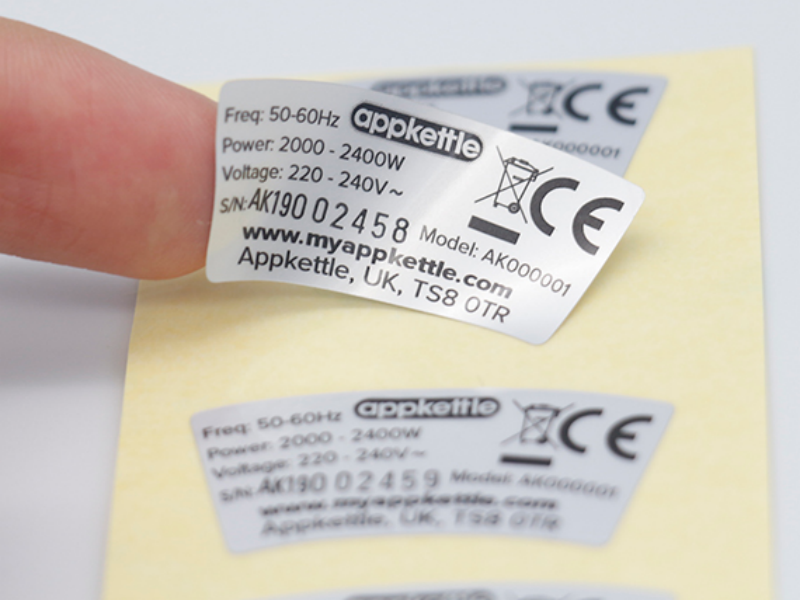
What Is a Self-Adhesive Label?
Every pressure-sensitive label consists of three layers: the facestock (the printed surface), the adhesive layer beneath it, and a release liner you remove before application. Press the label against a surface and the adhesive bonds immediately - no activation required.
This differs from wet-glue labels - applied to glass beer and wine bottles using moisture-activated adhesive and specialized high-speed equipment. Self-adhesive labels work by hand or with standard automatic applicators, accommodate a wider range of container shapes, and scale from handmade products to high-speed packaging lines with equal ease.
Facestock Materials: The Core Decision
The facestock determines appearance, durability, and whether the label can survive its environment. Most label failures trace back to a material chosen without accounting for actual use conditions.
Paper Labels
Paper facestocks are cost-effective and available in three common finishes. Matte paper suits natural or artisan branding and is easy to write on. Glossy paper delivers vivid color and shelf impact - standard for retail packaged goods. Kraft paper, uncoated and textured, works well for eco-conscious or handmade product positioning.
All three share the same limit: moisture. Condensation, storage humidity, or oils migrating from a cosmetic formula will cause paper labels to bubble or detach. If your product contacts moisture at any stage from filling to end use, paper is the wrong base material - regardless of whether you use a gloss or matte finish.

Film Labels
BOPP (Biaxially Oriented Polypropylene) is the most widely used film facestock in commercial label production. Available in white, clear, and metallized versions, it prints cleanly, resists moisture, and balances durability with cost. Beverage, cosmetic, and household product labels default to BOPP for exactly this reason.
PE (Polyethylene) is flexible - it stretches slightly with the container rather than creasing at the edges, making it the right choice for squeezable tubes, flexible pouches, and soft-sided containers.
PVC is UV-resistant and highly weather-resistant, standard for outdoor stickers and vehicle decals. Polyester (PET) handles the most demanding conditions - resisting high temperatures, chemicals, and abrasion - used in industrial and automotive applications where other materials fail.
Specialty Facestocks
Foil labels signal premium quality with metallic gold or silver surfaces. Holographic film creates a diffractive rainbow effect for decorative or anti-counterfeiting use. Clear film produces a no-label look on glass or transparent containers. Destructible facestocks fragment on removal - used for tamper-evident seals and warranty labels.
Material Quick-Reference
| Material | Waterproof | Tear-Resistant | Primary Use | Relative Cost |
|---|---|---|---|---|
| Matte paper | No | No | Indoor retail, food jars | Low |
| Glossy paper | No | No | Retail packaging | Low |
| BOPP film | Yes | Yes | Beverages, cosmetics | Medium |
| PE film | Yes | Yes | Squeezable containers | Medium |
| PVC film | Yes | Yes | Outdoor, decals | Medium |
| PET / Polyester | Yes | High | Industrial, high-heat | High |
| Foil | Varies | Yes | Premium branding | High |
| Clear film | Yes | Yes | No-label look | Medium–High |

Adhesive Types: Where Most Sourcing Errors Happen
The adhesive layer attracts far less attention than the facestock, which is precisely why it causes disproportionate failures. Two variables drive selection: surface type and temperature range.
Permanent Adhesives
Standard permanent adhesives bond reliably to most smooth, clean surfaces - the default for product labels intended to last the product's lifetime. High-tack (aggressive) formulations handle difficult surfaces: rough cardboard, powder-coated metal, recycled-content substrates, and low-energy plastics such as polypropylene and polyethylene. On low-energy containers, a standard adhesive typically lifts at the edges within days; switching to high-tack solves this.
Freezer-grade adhesives maintain tack at temperatures down to −20°C or below. Standard adhesives stiffen in the cold and fail to bond consistently. For any product entering cold storage - especially when labels are applied before cooling - freezer-grade is a requirement, not an upgrade.
Removable and Specialty Adhesives
Removable adhesives hold firmly at first but release cleanly without residue - suited to promotional overlays, retail price stickers, and labels on reusable containers. A common misconception: removable does not mean weak. Many removable grades match permanent adhesives in short-term hold strength; the difference appears over time or in heat.
Repositionable adhesives can be applied, removed, and reapplied multiple times. Specialty formulations go further: ultra-removable grades for polished or easily marked surfaces, high-temperature adhesives rated above 150°C, and skin-safe biocompatible grades for medical applications.

Label Formats: Shape, Cut, and Configuration
Die-cut labels are cut to a specific custom shape using a purpose-made die blade - round, oval, logo-contoured, or any other form. Kiss-cut labels cut only through the facestock and adhesive, leaving the liner intact, so multiple shapes sit on a single backing sheet for users to peel individually. This is the format behind sticker sheets and promotional packs. For a full comparison of cost and application differences between the two approaches, see the die-cut vs. kiss-cut guide.
Roll labels are wound on a core for use with automatic applicators on packaging lines - standard for production volumes. Sheet labels are flat pages for desktop printers, suited to short runs, variable data, and on-demand application. Butt-cut rolls carry rectangular labels edge-to-edge; die-cut rolls carry shaped labels with the matrix material removed.
Digital vs. Flexographic Label Printing
Digital printing requires no printing plates. Minimal setup costs make it practical for short runs (typically 50–500 labels), multiple designs in a single order, variable data where each label carries unique information, and projects where specifications are still being confirmed.
Flexographic printing uses pre-made plates with setup costs that make small runs uneconomical. Below roughly 2,000–3,000 units, plate costs dominate the total price. Above that threshold, unit costs drop significantly, and flexo delivers consistent ink coverage at high production speeds. For how print methods compare across different packaging formats, see the overview of printing specifications.
Common Applications by Industry
Food and Beverage
Labels in this category face condensation on chilled products, refrigerator humidity, and in some cases freezer conditions. BOPP with a moisture-resistant adhesive is standard for refrigerated beverages; freezer-grade adhesive is required for frozen goods. Labels that contact food surfaces directly or indirectly may be subject to FDA 21 CFR regulations governing approved materials - confirm this with your supplier before finalizing specifications.
Cosmetics and Personal Care
Cosmetic labels face oils, lotions, water, and repeated handling. BOPP with gloss or matte lamination protects both the printed surface and the facestock. Soft-touch lamination is now standard on premium skincare and fragrance packaging. When the label is part of a coordinated system, custom cosmetic packaging can carry the same design language across both box and label.
Shipping and Logistics
Address labels, barcodes, and hazard warnings must survive conveyor handling, scanner requirements, and variable weather. Direct thermal and thermal transfer printing are standard for variable data in this context. For brands shipping in custom corrugated boxes, adhesion on recycled-content corrugated often requires high-tack adhesive - a detail worth specifying upfront.
Industrial and Safety
Equipment tags, compliance labels, and chemical markings in manufacturing environments require UV-stable inks, polyester facestock, and adhesives rated for specific temperature and chemical conditions. Standard labels consistently fail here. Specifying the actual operating environment before the label is designed - rather than after a failed run - is the single most useful step.
Three Questions to Ask Before You Specify
What surface is the label going on? Glass and aluminum bond easily with standard adhesives. Low-energy plastics - polypropylene and polyethylene containers - require high-tack formulations. Rough or recycled-content surfaces need aggressive adhesives. If labels have been lifting without an obvious cause, surface energy is usually the first thing to check.
What conditions will it face? Temperature range, moisture exposure, UV light, and chemical contact all point to different material combinations. A label that performs at room temperature in a dry environment may fail within weeks in a cold storage facility or humid warehouse.
How long does it need to last? A short-term promotional sticker and a warranty seal on industrial equipment have completely different requirements. Matching specifications to actual service life - rather than defaulting to the highest durability grade on everything - keeps costs appropriate without compromising performance.
Three Mistakes That Lead to Label Failures
Choosing paper for a wet application. Condensation, humidity, or oil migration will degrade a paper label. When moisture is present at any stage from filling to end use, film facestock is the minimum starting requirement.
Assuming waterproof facestock means waterproof printing. BOPP resists water; an unlaminated digital print on BOPP does not. Lamination or UV coating over the printed surface solves this - but it must be explicitly specified, not assumed.
Applying labels outside the adhesive's temperature window. Most standard permanent adhesives have a minimum application temperature around 10°C. Labels applied in a cold environment before freezing will show adhesion failure within days - sometimes not until the product is in distribution. Confirm the application temperature before ordering if cold-chain handling is involved.
Frequently Asked Questions
What is the difference between a self-adhesive label and a sticker?
Both are pressure-sensitive, peel-and-stick formats with the same three-layer construction. In packaging and commercial contexts, "label" describes products where identification, information, or compliance is the primary function. "Sticker" typically applies to decorative or promotional uses. The distinction is contextual rather than technical. For how labels relate to decals, see decal vs. sticker: how the formats actually differ.
Are self-adhesive labels waterproof?
Film facestocks - BOPP, PE, PVC, and PET - are water-resistant to varying degrees. Paper is not. Even on a water-resistant film, an unprotected print will smear when wet. Lamination or UV coating over the ink layer addresses this. Specify both facestock and finish to cover both variables.
How long do self-adhesive labels last?
Indoor paper labels in dry conditions can remain intact for several years. Outdoor-rated film labels with UV-stable inks and lamination are typically rated for 3 to 7 years under standard exposure. Material suppliers publish specific durability ratings on their datasheets - ask for this data if service life is a critical requirement.
Which printing method should I use?
For under 1,000 units or multiple designs, digital printing is almost always the right choice - no plate fees, fast setup, no penalty for ordering across different SKUs. For a single design at high volume (typically above 3,000 units), flexographic printing delivers lower per-unit cost once setup is amortized. If you are also ordering product boxes alongside your labels, combining both with one supplier simplifies specifications and often reduces lead time.
To discuss requirements or get pricing for a custom label run, browse our packaging range, contact us directly, or submit an inquiry.


