

Why Kids' Drawing Books Deserve Attention Beyond Art
When we talk about kids' drawing books, most parents first think of them as tools to nurture children's creativity and painting skills. However, behind every page that sparks a child's imagination lies a sophisticated world of printing technology. The quality of a kids' drawing book from the vividness of the sample patterns to the safety of the paper and ink depends largely on printing processes, printing materials, and printing quality control. In this blog, we will take a deep dive into the core of kids' drawing books, combining printing technology popularization with practical guidance, helping parents understand how to choose high quality drawing books that are both safe and educational, while exploring the authoritative standards that excellent printing brings to these children's treasures.
1,The Core Value of Kids' Drawing Books: More Than Just a Canvas for Painting
Kids' drawing books are far more than simple paper collections with blank pages or sample drawings. They are a bridge connecting children to the world of colors, shapes, and creativity. A well - designed drawing book can guide young children to recognize basic colors, understand simple composition, and even develop fine motor skills as they hold a crayon and draw along the lines. But none of these functions can be realized without reliable printing support.
1, The printing of sample patterns in drawing books is crucial. High - definition printing ensures that the sample patterns are clear and the colors are accurate. For example, using advanced digital printing technology, the gradient of colors in a small animal sample can be presented smoothly, allowing children to have a correct understanding of color matching. If the printing is blurry or the color is distorted, it will not only affect the child's painting interest but also mislead their perception of colors.
2, The printing material of the drawing book is directly related to the child's health. Children often have the habit of biting books or touching the pages with their hands and then putting them in their mouths. Therefore, the paper used for the drawing book must be non - toxic and environmentally friendly, and the ink must be food - grade or meet the strictest children's product safety standards. The ink printing process is also very important. The use of water - based ink instead of oil - based ink can reduce the emission of harmful substances, ensuring that the drawing book is safe for children to use.
3,The binding printing of the drawing book affects its durability. Kids are usually not gentle when using books; they may tear the pages or fold them randomly. A drawing book with good binding, such as saddle - stitch binding or perfect binding that has undergone strict printing quality inspection, can withstand the "torture" of children and be used for a longer time, making it more cost - effective for parents.
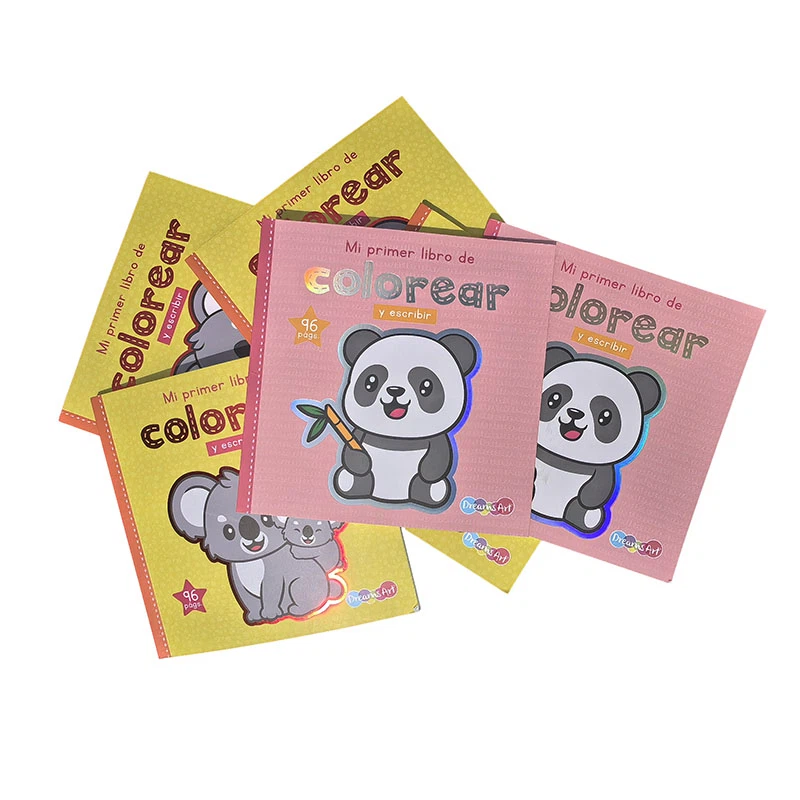
2,Popular Science of Key Printing Technologies for Kids' Drawing Books: From Traditional to Digital
To better understand the quality of kids' drawing books, it is necessary to understand the common printing technologies used in their production. Each printing technology has its own characteristics, and their application directly affects the performance of the drawing book in terms of color, clarity, and cost.
a. Offset Printing: The Traditional Choice for Mass - Produced Drawing Books
Offset printing is one of the most widely used traditional printing technologies in the production of kids' drawing books, especially for large - batch printing. Its core principle is to transfer the ink from the printing plate to the rubber blanket first, and then from the rubber blanket to the paper. This indirect printing method ensures that the printed pattern is clear and the color is stable.
In the production of kids' drawing books, offset printing has obvious advantages. First, it can achieve high - quality color reproduction. For drawing books with rich and bright colors, such as those with various cartoon characters and landscape samples, offset printing can accurately present the designed colors, making the patterns more attractive to children. Second, the cost of offset printing for large - batch production is relatively low, which helps to reduce the selling price of drawing books, making high - quality products more accessible to ordinary families.
However, offset printing also has some limitations. It requires the production of printing plates, so the setup cost is relatively high for small - batch printing. In addition, the drying speed of the ink used in offset printing is relatively slow. If the post - processing is not timely, it may cause ink smudges, which affects the quality of the drawing book. Therefore, in the offset printing process of kids' drawing books, strict printing quality control is required, including controlling the ink viscosity, adjusting the printing pressure, and ensuring sufficient drying time.
b. Digital Printing: The Innovative Force for Personalized and Small - Batch Drawing Books
With the development of printing technology, digital printing has gradually become a new favorite in the production of kids' drawing books, especially for personalized and small - batch orders. Digital printing does not require the production of printing plates; it directly prints the digital pattern files onto the paper through inkjet or laser technology.
The biggest advantage of digital printing in the production of kids' drawing books is its strong personalized customization ability. Parents can upload their children's photos or design unique patterns (such as the child's name, favorite small animals, etc.) to the printing company, and the company can print these personalized elements into the drawing book. This kind of personalized drawing book is not only more attractive to children but also has a unique commemorative value.
In addition, digital printing has a fast response speed. Since there is no need to make printing plates, the production cycle of digital printing is much shorter than that of offset printing. For parents who need to get a drawing book quickly (such as for a child's birthday gift), digital printing is a better choice. Moreover, digital printing can achieve variable data printing, which means that each page of the drawing book can have different patterns, which enriches the content of the drawing book and increases the fun of children's painting.
However, digital printing also has some shortcomings. The cost per page for small - batch printing is higher than that of offset printing. In addition, the color fastness of some digital printing inks needs to be improved. If the drawing book is often exposed to sunlight or water, the color may fade. Therefore, when choosing a digital printing drawing book, parents should pay attention to asking about the type of ink used and whether it has passed the color fastness test.
c. Screen Printing: The Special Technology for Textured Drawing Books
Screen printing is a special printing technology that is often used to produce kids' drawing books with a textured surface. Its principle is to use a screen with a pattern as a printing plate, and the ink passes through the mesh of the screen to print the pattern onto the paper.
The biggest feature of screen printing is that it can print a thick ink layer, making the pattern on the drawing book have a three - dimensional effect and a tactile texture. For example, in a drawing book about fruits, the surface of the apple pattern printed by screen printing can be slightly raised, and children can feel the "roundness" of the apple by touching it. This kind of tactile experience can greatly stimulate children's sensory development and make the painting process more interesting.
In addition, screen printing has strong adaptability to printing materials. It can not only print on ordinary paper but also on special materials such as plastic sheets and fabric, which expands the types of kids' drawing books. For example, some waterproof drawing books for children to use in the bathroom are made of plastic sheets printed by screen printing.
However, screen printing is not suitable for printing complex patterns with many colors. Because each color needs a separate screen, the production process is relatively complicated, and the cost will increase with the increase of colors. Therefore, screen printing is usually used for drawing books with simple patterns and a small number of colors but requiring a textured effect.
3,User Demand - Oriented: How to Choose a High - Quality Kids' Drawing Book Based on Printing Characteristics
Every parent has different needs when buying a kids' drawing book. Some parents pay more attention to the safety of the book, some care about the educational value, and others focus on the durability. Combining the printing characteristics of drawing books, we can provide targeted purchase suggestions for different user needs.
a. For Parents Who Prioritize Safety: Focus on Printing Materials and Ink
Safety is the top priority for parents when choosing kids' drawing books. To ensure the safety of the drawing book, parents should first pay attention to the printing materials and ink used.
When checking the printing materials, parents should look for drawing books made of high - quality, non - toxic paper. The paper should be thick enough to prevent children from easily tearing it, and it should not have a pungent smell. Some high - end drawing books use recycled paper that has passed environmental protection certification, which is not only environmentally friendly but also safe for children.
In terms of ink, parents should choose drawing books printed with water - based ink or soy ink. These inks are made of natural materials and do not contain harmful substances such as heavy metals (lead, mercury, cadmium) and volatile organic compounds (VOCs). Parents can check the product description or certification marks on the drawing book. For example, the "AP" certification mark issued by the Art and Creative Materials Institute (ACMI) indicates that the product is non - toxic and safe for children.
In addition, parents should also pay attention to the printing process of the drawing book. If the drawing book has a glossy surface, it may have used a coating. Some coatings contain harmful substances, so it is better to choose drawing books without coating or with water - based coating.
b. For Parents Who Value Educational Value: Pay Attention to Printing Clarity and Pattern Design
The educational value of a kids' drawing book is mainly reflected in its ability to guide children's learning and development through patterns and content. The printing clarity of the drawing book directly affects the educational effect.
A drawing book with high printing clarity can present the details of the sample patterns clearly. For example, in a drawing book that teaches children to recognize animals, the eyes, ears, and fur of the animals should be printed clearly, so that children can observe the characteristics of the animals and draw them correctly. If the printing is blurry, children may not be able to distinguish the details of the patterns, which will affect their learning effect.
In addition to printing clarity, the design of the patterns is also very important. The patterns should be age - appropriate. For young children aged 2 - 3, the patterns should be simple and large, such as circles, squares, and simple animal shapes, which are easy for them to imitate. For older children aged 4 - 6, the patterns can be more complex, such as scenes with multiple characters and objects, which can cultivate their observation ability and composition ability.
The color printing of the drawing book also plays a role in education. The colors should be bright and natural, which can stimulate children's interest in colors and help them establish a correct color concept. At the same time, the color matching of the patterns should be reasonable, which can subtly cultivate children's aesthetic ability.
c. For Parents Who Care About Durability: Focus on Binding Printing and Paper Thickness
Kids are usually rough on books, so the durability of the drawing book is an important factor for many parents. The durability of the drawing book is closely related to its binding printing and paper thickness.
In terms of binding printing, saddle - stitch binding and perfect binding are the two most common binding methods for kids' drawing books. Saddle - stitch binding is suitable for thin drawing books; it uses staples to bind the pages, which is simple and firm. Perfect binding is suitable for thick drawing books; it uses glue to bind the pages to the cover, which has a neat appearance and good durability. Parents should check the binding of the drawing book when purchasing: the staples of saddle - stitch binding should not be loose, and the glue of perfect binding should not be overflowing or falling off.
The thickness of the paper also affects the durability of the drawing book. Thicker paper is more resistant to tearing and folding. For example, drawing books made of 120g - 150g paper are more durable than those made of 80g - 100g paper. In addition, some drawing books use coated paper or cardstock, which has better water resistance and wear resistance, making the book more durable.
4,Authoritative Standards and Professional Certification: The Guarantee of High - Quality Kids' Drawing Books
The quality of kids' drawing books is not only determined by printing technology and materials but also constrained by authoritative standards and professional certifications. These standards and certifications provide a scientific and strict evaluation system for the production of kids' drawing books, ensuring that the products meet the highest safety and quality requirements.
a. International Safety Standards for Kids' Products
There are many international safety standards for kids' products, and the most influential ones include the European Union's EN 71 standard and the United States' ASTM F963 standard. These standards have strict regulations on the materials, ink, and printing of kids' drawing books.
The EN 71 standard includes multiple parts, among which EN 71 - 3 specifies the limit requirements for soluble heavy metals in toys and children's products. For kids' drawing books, this standard requires that the content of heavy metals such as lead, mercury, cadmium, chromium, and arsenic in the paper and ink must be lower than a certain limit. The ASTM F963 standard also has similar requirements for heavy metals and other harmful substances, and it also includes tests on the flammability of the product to prevent fire hazards.
Drawing book manufacturers that comply with these international standards will usually print the corresponding certification marks on their products. Parents can look for these marks when purchasing, such as the "CE" mark (indicating compliance with EU standards) or the "ASTM" mark (indicating compliance with US standards), to ensure that the drawing book they buy is safe.
b. Professional Printing Quality Certification
In addition to product safety standards, there are also professional printing quality certifications that can reflect the quality of kids' drawing books. For example, the ISO 9001 Quality Management System Certification and the ISO 14001 Environmental Management System Certification are important indicators to measure the comprehensive strength of a printing company.
A printing company with ISO 9001 certification has a strict quality management system, which can ensure that every link in the production of drawing books-from the purchase of raw materials to the final inspection-meets the quality requirements. The ISO 14001 certification indicates that the printing company pays attention to environmental protection, and its production process is in line with environmental protection requirements, which is also beneficial to the production of safe and environmentally friendly kids' drawing books.
In addition, some countries and regions have their own printing quality certifications. For example, in China, the "National Printing Quality Award" is a high - level honor in the printing industry. Drawing books printed by companies that have won this award usually have excellent printing quality.
5,The Future of Kids' Drawing Books: The Integration of Printing Technology and Intelligent Innovation
With the continuous development of science and technology, the field of kids' drawing books is also ushering in new changes. The integration of printing technology and intelligent innovation will bring more novel and interesting products to children.
a. 3D Printing: Creating Three - Dimensional Drawing Books
3D printing technology is gradually entering the field of kids' drawing books, bringing a revolutionary change to the traditional flat - page drawing books. 3D printing can print three - dimensional patterns and structures on the pages of the drawing book, making the book more vivid and interesting.
For example, a 3D printed drawing book about dinosaurs can have three - dimensional dinosaur models on the pages. Children can not only draw on the flat part of the page but also touch and observe the three - dimensional dinosaur models, which enhances their understanding of dinosaurs. In addition, 3D printing can also print detachable parts on the drawing book. For example, children can assemble a three - dimensional car model by detaching the parts printed on the book, which combines painting and hands - on ability training.
However, the current cost of 3D printing is still relatively high, and the production speed is slow, which limits its large - scale application in the production of kids' drawing books. But with the continuous maturity of 3D printing technology, it is believed that in the near future, 3D printed drawing books will become more popular.
b. AR Printing: Realizing the Interaction Between Virtual and Real
AR (Augmented Reality) printing is another important direction for the development of intelligent kids' drawing books. AR printing combines traditional printing with AR technology. By printing special markers on the pages of the drawing book, children can use a mobile phone or tablet to scan the markers, and the virtual images corresponding to the patterns will be displayed on the screen.
For example, in an AR drawing book about animals, when children finish drawing a small cat on the page and scan the page with a mobile phone, a virtual small cat will jump out of the screen, walk, meow, and even interact with the child. This kind of interactive experience can greatly stimulate children's interest in painting and make the painting process more fun.
In addition, AR printing can also add educational content to the drawing book. For example, when children scan a pattern of a planet, the virtual image can not only display the appearance of the planet but also play a short video introducing the knowledge of the planet, which expands children's horizons.
6,Choosing the Right Kids' Drawing Book with the Help of Printing Knowledge
Kids' drawing books are an important part of children's growth. They not only cultivate children's creativity and painting skills but also affect their health and development. Behind every high - quality kids' drawing book is the support of advanced printing technology, high - quality printing materials, and strict printing quality control.
By understanding the printing technologies (such as offset printing, digital printing, and screen printing) used in the production of drawing books, the characteristics of printing materials and ink, and the relevant authoritative standards and certifications, parents can better choose a drawing book that is suitable for their children. Whether it is a traditional drawing book with excellent offset printing quality, a personalized digital printing drawing book, or a future - oriented 3D printed or AR printed drawing book, as long as it meets the requirements of safety, education, and durability, it can become a good partner for children's growth.
In the future, with the continuous innovation of printing technology, kids' drawing books will definitely show more new forms and functions. Let us look forward to it together and provide our children with a better painting and growth experience with the help of advanced printing technology.


