

If you've ever received a printer's quote sheet and found yourself Googling half the terms on it, this guide is for you. What follows covers every major book printing and binding method with enough specificity to actually inform a decision - not just define a term.
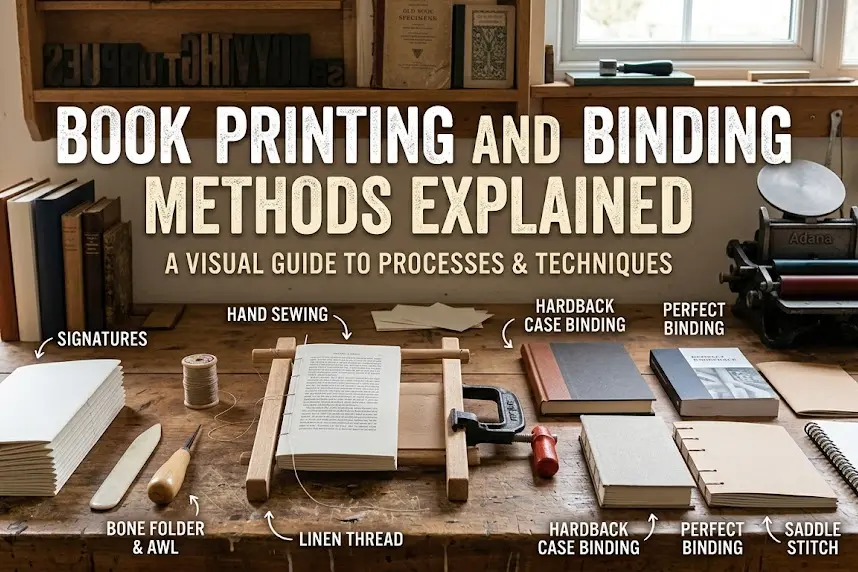
Printing Methods: Offset vs. Digital
The real decision between offset and digital printing isn't about quality. Modern digital presses running commercial-grade toner or inkjet systems produce results that are genuinely indistinguishable from offset for most text-heavy content. The decision is economic and logistical - and once you understand the cost structure of each method, the choice usually becomes obvious.
Offset Printing
Offset printing transfers ink from metal plates onto a rubber blanket, which then presses the image onto paper. Those plates are burned from your digital files, and the setup process - called makeready - requires time and labor before a single sellable sheet comes off the press. That front-loaded cost is why offset only makes economic sense above a certain volume threshold. For most standard book formats, that threshold sits somewhere between 500 and 1,000 copies; below that, the setup cost per unit outweighs the efficiency gains.
What offset delivers in return is exceptional color consistency held across an entire run, and per-unit cost that drops sharply as volume climbs. For large-format picture books with full-bleed illustration spreads, premium gift books where color accuracy matters, and textbooks ordered in the thousands, offset remains the standard. Pantone spot colors - a fifth or sixth ink unit not available on digital presses - are also exclusive to offset, which matters for books where brand color matching is non-negotiable.
Digital Printing
Digital printing skips plates entirely. Files go straight to the press, which means zero setup time, no minimum order quantity, and the ability to update content between print jobs at no penalty. Print-on-demand publishing platforms like Ingram Spark operate entirely on digital press infrastructure - every copy is printed when an order is placed, with no inventory risk.
The per-unit cost is higher than offset at volume, but for short runs - typically 50 to 300 copies - digital is almost always cheaper in total. For a 100-copy corporate report, a limited-edition author proof run, or a children's picture book being test-printed before a larger offset order, digital is the right tool. The quality caveat applies mainly to full-color, image-heavy books where ink saturation and dot reproduction are critical; for those, offset still has a visible edge at higher page counts. For everything else, the gap is minor and rarely worth the volume commitment offset requires.
The practical rule: under 500 copies, or content that changes between print runs, go digital. Over 1,000 copies with color-critical content, offset will cost less and look better. The 500–1,000 range is genuinely a judgment call that depends on your specific content, format, and timeline.
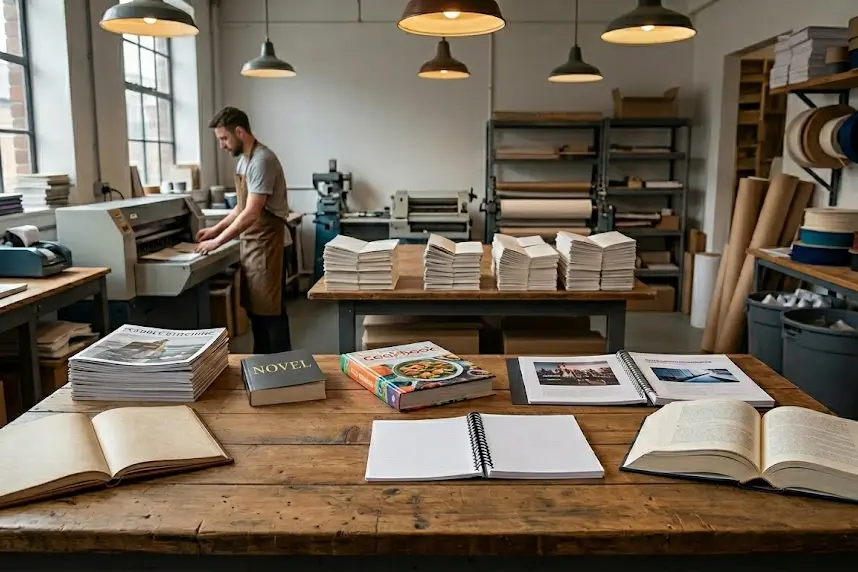
Book Binding Methods: What Each One Actually Does
Binding is where most first-time publishers make avoidable mistakes, usually because the method is chosen at the end when budgets are tight and options feel limited. In practice, each book binding method exists to solve a specific combination of constraints - page count, usage pattern, cost ceiling, and whether the book needs to lie flat. Understanding those constraints makes the decision straightforward rather than confusing.
Saddle Stitching
Saddle stitching is the binding you've handled every time you've picked up a magazine. Printed sheets are nested inside each other, folded together, and stapled through the fold line with wire staples. The entire publication is a single folded unit - no separate spine, no adhesive, no complex machine setup. Per-unit cost is the lowest of any binding method, and turnaround is fast.
The page count ceiling is firm. Because saddle-stitched books are built from folded, nested sheets, paper thickness accumulates toward the center. Above roughly 64 pages on standard 60 lb text stock - sometimes 80 pages with very lightweight paper - the outer pages begin pushing past the page edges, the staples have trouble holding tension, and production quality suffers. Below that threshold, saddle stitch is fast, inexpensive, and looks clean. It's the default for booklets, event programs, small product catalogs, and thin magazines. The finished piece also opens completely flat, which is genuinely useful for instructional content where readers need both hands free.
Perfect Binding
Perfect binding is the standard construction for paperbacks. Folded signatures are gathered in sequence, their folded spines milled off by a rotating cutter to expose raw paper fibers, and adhesive is applied to that roughened surface before the wraparound cover is pressed against it. The result is a squared spine that carries the book's title, a retail-ready appearance, and a cost point that makes it the dominant method for commercial softcover production.
Page count range runs from roughly 50 pages up to around 600 pages. For most standard book printing projects - novels, catalogs, trade paperbacks, brand publications - perfect binding is the default for good reason.
One adhesive choice that often gets skipped in early planning: EVA versus PUR. Standard EVA (ethylene vinyl acetate) hot-melt adhesive is fast to cure and works well for books that will be read a limited number of times. PUR (polyurethane reactive) adhesive creates a stronger, more flexible bond that resists temperature extremes, repeated flexing, and heavy handling - it typically runs about 15–20% more per unit. For textbooks, cookbooks, manuals, or any book that will be opened frequently or carried in a bag, PUR is worth specifying. A perfect-bound textbook with EVA adhesive will start delaminating at the spine within a year of classroom use; the same book with PUR holds up significantly longer. This distinction rarely appears on standard quote sheets, so it's worth asking about directly.
One functional limitation to plan around: perfect-bound books don't open completely flat. The adhesive spine creates resistance every time the book opens. For content requiring one free hand - cookbooks propped on a counter, sheet music, instructional workbooks - this is a real usability problem, not just a preference. In those cases, a lay-flat binding method is the correct specification.
Case Binding (Hardcover)
Case binding constructs a book in two separate stages. The interior pages are first assembled into a book block - either sewn or glued - and then that finished block is attached to a pre-made rigid case made from dense binder's board covered in cloth, paper, or a synthetic material. A flexible hinge area at each side of the spine allows the heavy cover to open without stressing the attachment point. Dust jackets are typically added over the case for retail books.
The result is the most durable binding format in common commercial production. A well-made case-bound book, handled normally, can survive decades of reading. That durability costs more - case binding typically runs two to three times the per-unit cost of perfect binding, and production time is longer. For hardcover novels, reference books, premium gift editions, and any book where perceived value at the point of sale matters, the premium pays off.
The specific use case where case binding is genuinely non-negotiable: books expected to be opened thousands of times over many years. Our Bible printing work always uses case binding with Smyth-sewn interiors, because a Bible is opened daily by many of its owners and the construction needs to hold for decades under that level of use. Adhesive-only binding simply doesn't meet that standard.
Spiral and Coil Binding
Spiral binding threads a continuous plastic coil through a row of punched holes along the binding edge. Pages rotate a full 360 degrees, meaning the book can fold completely back on itself and lie flat without any structural stress. For workbooks, planners, reference materials, and anything that needs to stay open hands-free on a flat surface, this is typically the right call. Our notebook printing production uses spiral binding as standard because writers need to hold a pen with one hand while flipping pages with the other - a perfect-bound notebook actively works against that.
The tradeoffs are cosmetic rather than functional. The coil spine cannot carry printed text, so shelving requires labels or a separate organization system. The appearance reads as informal - it signals workbook or reference tool rather than published book - which is a real consideration for anything sold at retail. Coils are available in various diameters and colors, which allows some aesthetic flexibility for projects where the look matters.
Wire-O Binding
Wire-O uses pre-formed double-loop wire clinched through punched holes instead of a continuous coil. Pages still lie flat and rotate freely, but the finished appearance is noticeably cleaner and more structured than plastic spiral - the wire holds its shape better under compression and looks more deliberate. Wire-O is the standard for calendars, desk planners, corporate presentations, and technical reference documents where both lay-flat function and a polished appearance matter. The practical difference between spiral and Wire-O is partly structural (wire resists deformation better during shipping) and partly perceptual: Wire-O reads as more professional to most clients and end users, at a slightly higher production cost.
Smyth-Sewn Binding
Smyth sewing stitches folded page signatures together with thread before any cover or adhesive is applied. The sewn structure is mechanically strong in a way no glued-only binding can replicate - individual pages resist pulling out even after years of heavy use, and the book block stays flexible enough to open comfortably. This is typically the interior construction method inside premium hardcover case bindings, though it's also used for certain softcover applications requiring genuine lay-flat performance.
One production detail that surprises many clients: in Smyth-sewn construction, the spine milling step used in standard perfect binding is skipped entirely. The sewn signatures already hold the book block together, so there's no need to roughen the spine surface for adhesive grip. This also means designers don't need to add extra inner margin allowance on the binding edge - content can run closer to the gutter without risk of being trimmed away during production.
Children's picture books and board books that are loved hard by young readers often use a variant of this sewn construction precisely because it survives physical stress that no adhesive binding can match. For detailed production specs on that construction, see our board book printing page.
Paper Stock and Cover Finish: Decisions That Happen in Parallel with Binding
Paper choice and binding choice interact in ways that aren't always obvious - and choosing one without the other leads to avoidable production conflicts. A few rules that come up consistently:
- Coated stocks for image-heavy books. The coating fills paper fibers and lets ink sit on the surface rather than absorbing into it - that's what produces sharp, vibrant photographs. Use coated paper for picture books, art books, cookbooks with photography, and catalogs. Standard specs: 157 gsm (105 lb) for interior spreads, 250–300 gsm for cover stock.
- Uncoated stocks for text-heavy books. 60 lb or 70 lb offset paper is the standard for novels and nonfiction. Easier on the eye under extended reading, lower cost, no glare under direct light. Cream-tinted uncoated paper is common for literary fiction where the warmer tone is a design choice.
- Heavier stocks increase spine width - which changes your cover file. A 300-page book on 80 lb coated stock will have a noticeably thicker spine than the same book on 60 lb uncoated. That spine width needs to be calculated before your cover file is designed. A cover built around the wrong spine width is the most common file correction in book production.
- Saddle stitch has a weight ceiling. Very heavy interior stocks (above 100 lb text) make folded sheets too stiff to nest and staple properly. If your publication is image-heavy and uses thick paper, saddle stitch may not be feasible regardless of page count - confirm before designing to that spec.
- Thin stocks cause adhesive bleed-through in perfect binding. Paper under 50 lb text can allow hot-melt adhesive to bleed through to visible interior pages at the gutter. Easily avoided by confirming paper weight with your printer before final spec sign-off.
Cover finish works the same way - it should be decided early, not chosen from a dropdown at the end. Gloss lamination makes colors vivid and gives a commercial appearance; matte lamination reads as quieter and more refined, now the default for literary fiction and brand-led publications. Soft-touch matte lamination adds a velvety tactile quality associated with premium design. Spot UV coating - a gloss lacquer applied selectively over a matte base - is one of the most cost-effective ways to make a cover feel premium. Foil stamping adds metallic or colored foil under heat and pressure, most commonly for hardcover title treatments.
For illustrated children's book printing specifically, soft-touch lamination combined with spot UV on title elements is a near-universal spec for premium picture book covers - tactilely engaging for young readers, and a signal of quality to parents at the point of purchase.
Matching Your Project to the Right Method
Rather than asking which binding is best in general, the more productive question is: what will this book be used for, by whom, how often, and in what environment? Those answers determine the spec faster than any quality ranking.
| Project Type | Printing Method | Binding Method | Key Reason |
|---|---|---|---|
| Trade paperback novel, 200–400 pp, retail | Offset (1,000+) or digital | Perfect binding (PUR for heavy use) | Cost-efficient; printable spine for retail shelf |
| Premium hardcover - gift book, reference, collectible | Offset | Case binding, Smyth-sewn interior | Durability + perceived value at point of sale |
| Corporate booklet or event program, under 64 pp | Digital | Saddle stitch | Fastest turnaround, lowest cost, opens flat |
| Cookbook, manual, or workbook (lay-flat required) | Digital or offset | Wire-O or spiral | Lay-flat function; formal appearance secondary |
| Custom notebook or planner | Digital or offset | Spiral (budget) or Wire-O (polished) | Write-in usability; 360-degree page rotation |
| Children's board book | Offset | Case binding, laminated board pages | Toddler durability governs every material choice |
| Bible or long-use devotional | Offset | Case binding, Smyth-sewn, thin Bible paper | Must survive daily use for years, often decades |
| Short-run proof or test edition | Digital | Perfect binding or saddle stitch | No minimum quantity; fast revision cycle |
Paper selection should enter this conversation at the same time as binding, not afterward. For educational publishing specifically, the combination of binding method, paper weight, and adhesive type has a measurable effect on how long a book survives classroom use - which directly affects total cost of ownership for the institutions purchasing them.
Questions about production specs, minimum quantities, or format compatibility for your specific project? Our team handles custom OEM and ODM book printing across all of the formats covered in this guide. For an overview of our material controls and production standards, see our quality management process.
Frequently Asked Questions
What is the minimum page count for perfect binding?
Most manufacturers set the practical minimum at 50 to 60 pages. Below that threshold, the spine is too narrow for the adhesive to create a reliable bond - the book looks more like a thick pamphlet than a proper softcover, and the cover may not stay flat against the spine edge. Some facilities can produce perfect-bound books as thin as 40 pages using narrow-spine equipment, but it's worth confirming before submitting files, since not all shops support it.
What is the difference between EVA and PUR adhesive in perfect binding?
EVA (ethylene vinyl acetate) is the standard hot-melt adhesive used in most perfect binding. It cures quickly and works well for books that will be read a limited number of times. PUR (polyurethane reactive) adhesive forms a stronger, more flexible chemical bond that resists temperature extremes, repeated opening, and heavy handling - at roughly 15–20% higher cost per unit. For textbooks, reference manuals, cookbooks, and any book opened frequently or carried in a bag, PUR is the more durable spec. For a novel read once or twice, EVA is adequate.
What's the difference between spiral binding and Wire-O binding?
Spiral uses a single continuous plastic coil wound through punched holes - pages rotate 360 degrees and the book folds completely back on itself. Wire-O uses pre-formed double-loop wire clinched closed through the same type of holes - pages still lie flat, but the book cannot fold fully back without risking wire deformation. Wire-O has a cleaner, more structured appearance and holds its shape better under compression during shipping. Spiral is typically less expensive and available in more colors. For client-facing materials, Wire-O reads as more professional. For internal workbooks and personal notebooks, spiral is fully appropriate.
When does Smyth sewing make sense for a softcover book?
Smyth sewing inside a softcover - sometimes called a sewn paperback - is the right spec when the book needs to open completely flat and survive heavy repeated use, but the weight or cost of a hardcover isn't appropriate. Cookbooks, medical reference guides, educational workbooks, and art instruction books are common applications. The sewn structure allows full flat opening without cracking the spine, which adhesive-only perfect binding cannot reliably do after dozens or hundreds of uses. It's a minority specification, but the correct one for that combination of requirements.
Does binding method affect retail distribution compatibility?
Yes. Major retailers and online distribution platforms have specific requirements around binding methods, trim sizes, and spine width minimums. Perfect binding is the most universally accepted method for retail book distribution. Saddle-stitched publications are typically classified as magazines or booklets rather than books by distribution systems. Spiral and Wire-O bound books are generally incompatible with standard bookselling channels because the exposed hardware prevents them from standing upright on shelves. If retail distribution is part of the plan, confirm binding compatibility with your distribution partner before finalizing specs - not after printing.
How much does book printing cost, and what drives the price?
Book printing cost is driven primarily by four variables: quantity, page count, color vs. black-and-white interior, and binding method. As a rough reference point, a 200-page black-and-white perfect-bound trade paperback typically runs between $2 and $5 per unit at 1,000 copies on offset; at 100 copies on digital, the same book might run $8–$15 per unit. Hardcover adds approximately $2–$5 per unit over comparable softcover specs. Full-color interiors can increase per-unit cost by 50–200% depending on paper stock and print method. For accurate pricing on your specific project, a detailed spec sheet submitted for a formal quote is the most reliable approach. You can reach our team through the contact page for a project estimate.
What's the standard construction for children's board books?
Board books use thick laminated paperboard pages - typically 2mm to 3mm grey board laminated with printed paper on both sides - rather than standard paper pages. The binding is case construction with the board pages either glued or sewn directly into the cover structure; the thick pages themselves are load-bearing. Because the audience is toddlers, durability governs every material decision: the board must resist bending, the lamination must hold under moisture and repeated handling, and the spine must not separate under the kind of force a two-year-old routinely applies. Our children's book printing process builds these requirements into the material specification from the outset, not as a post-production adjustment.
Is offset printing always better quality than digital?
Not categorically. For text-heavy books, modern commercial digital presses produce results visually indistinguishable from offset at reading distance. The gap becomes meaningful for full-color illustration-heavy books - children's picture books, art photography books, premium gift titles - where ink saturation, color accuracy, and consistency across thousands of copies are critical. In those categories and at volumes above roughly 1,000 copies, offset has a measurable advantage. For everything else, the more useful question is which method serves your specific content at your specific quantity and budget. Those answers are usually different for different projects.


