

Print on demand (POD) means a book is printed only after someone orders it. No inventory is produced in advance. No warehouse space is needed. Each copy is printed, bound, and shipped individually-triggered by a single confirmed sale.
For an independent author, that changes everything about the economics of publishing. A first novel no longer requires a $3,000 upfront investment in 500 copies that may sit in a garage for two years. A textbook publisher can push a content update without writing off an existing print run. A small press can offer 40 backlist titles without carrying inventory on any of them.
But POD is not the right model for every project. It has real cost ceilings, quality limitations, and margin constraints that most introductory guides gloss over. This article covers how POD actually works, where it fits in a book publishing strategy, and when working directly with a professional book printing manufacturer makes more financial sense.

How Print on Demand Works, Step by Step
The process is more automated than most people expect the first time they encounter it.
- File preparation. The publisher or author creates a print-ready PDF file-separate files for the interior and cover, set to CMYK color, with proper bleed (typically 0.125 inches on all sides). This is the same spec whether you're using a POD platform or a traditional printing factory.
- Platform listing. The file is uploaded to a POD platform (such as IngramSpark or Amazon KDP Print) or to a direct-to-consumer store connected to a fulfillment partner. The title goes live without any physical copies being produced.
- Order trigger. A customer places an order. That order is automatically routed to the print provider-no manual intervention required on the seller's side.
- Production. The print provider runs the job on a digital press, binds the book in the specified format (perfect bound, case bound, saddle-stitched, or coil), and packages it.
- Fulfillment. The finished copy ships directly to the customer, often under the publisher's brand. The seller never handles the physical product.
The technology making single-copy economics viable is digital printing-primarily high-speed inkjet and laser presses. Unlike offset printing, which requires physical plates and long setup runs to recover fixed costs, digital presses have near-zero per-job setup costs. That is why one copy can be produced at a reasonable unit price rather than requiring a 500-copy minimum.
POD vs. Offset Printing: The Cost Comparison That Actually Matters
The standard comparison-"POD costs more per unit than offset"-is true but incomplete. The number that matters is total capital at risk, not unit cost in isolation.
Consider a 200-page paperback:
- A 1,000-copy offset run might cost $2.50 per book, totaling $2,500 upfront.
- The same title printed digitally one copy at a time costs around $5.50–$7.00 per copy.
Offset looks cheaper. But that $2,500 is spent before a single sale. If the book sells 200 copies, the effective cost per sold copy is $12.50-more than double the POD rate. Unsold inventory has carrying costs, storage costs, and eventual disposal costs that rarely appear in the original calculation.
POD inverts that risk profile. You pay more per copy, but only when you have a confirmed buyer. For runs under approximately 300 copies, POD is almost always the lower-risk financial choice, even when the per-unit figure looks worse on a spreadsheet.
For runs of 500 or more copies of a title with demonstrated demand, offset printing from a professional manufacturer typically becomes the better economic choice-lower unit cost, higher quality ceiling, and full control over materials and finishing. The crossover point depends on your wholesale pricing, distribution channel, and how stable the content is likely to remain.
Which Book Types Work Well for POD-and Which Don't
POD performs differently across book categories. Knowing where it fits saves a lot of wasted effort.
Strong fit: Novels, memoirs, and text-heavy paperbacks are the best match. Black-and-white interiors printed digitally are functionally indistinguishable from offset output in standard reading conditions. Perfect binding holds well at common trim sizes (5×8, 6×9). Per-unit cost is manageable, and demand for these titles is rarely predictable enough to justify a large print run upfront.
Good fit with caveats: Self-help books, business titles, and how-to guides sell well through POD because their audiences are reachable online, their price points absorb the higher unit cost, and content often needs periodic updates. POD's ability to push a revised edition instantly-without obsoleting existing inventory-is a genuine operational advantage here.
Requires evaluation: Children's book printing is more nuanced. Full-color picture books and softcover board books are technically achievable through modern digital printing, and quality has improved substantially in recent years. However, titles requiring thick board pages, specialty lamination, or premium case binding typically come out better-and cheaper at volume-through a dedicated manufacturing run. The same applies to Bible printing, where thin Bible paper, gilded page edges, and premium leather or bonded covers are finishing details that POD platforms simply do not offer.
Poor fit: Textbook printing at institutional scale rarely works through POD. Complex multi-column layouts, technical diagrams, durable binding requirements for heavy daily use, and the volume expectations of school or university procurement all push toward traditional manufacturing. Similarly, notebooks and journals designed for retail distribution need per-unit costs low enough to clear wholesale margins-which typically requires offset or bulk digital runs rather than single-copy POD fulfillment.
The Real Advantages of POD (And the Limitations Most Guides Skip Over)
The advantages are real. They're just more specific than they're usually described.
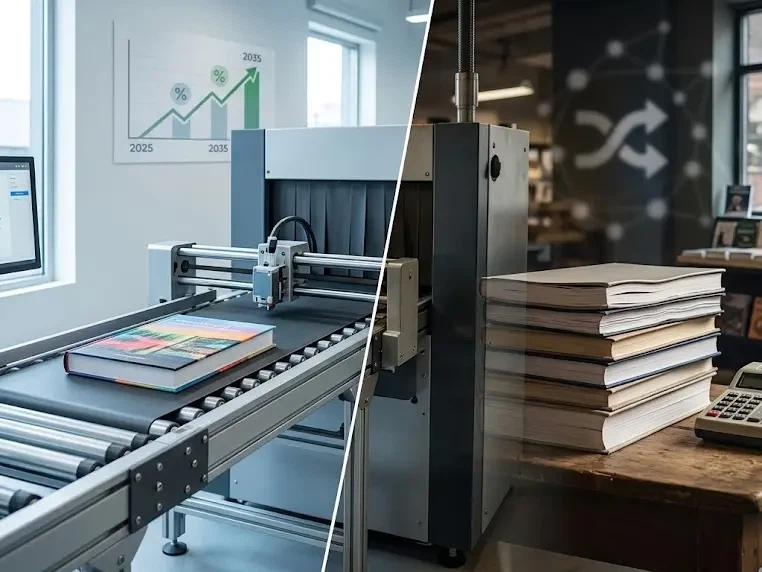
Zero inventory risk is the most legitimate benefit-particularly for new titles, self-published authors, or publishers testing a niche. The global POD market was valued at approximately $12.96 billion in 2025 and is projected to reach $118.85 billion by 2035, growing at a compound annual rate of around 25%, according to Precedence Research. That sustained growth reflects real demand, not hype.
Content flexibility has practical value for publishers managing living documents. A business book that references current statistics, a training manual updated quarterly, or a children's series with ongoing illustration revisions-all of these benefit from the ability to update a file and have the next order reflect the new version automatically.
Low barrier to launch matters for independent creators. A title can go from finished manuscript to available-for-purchase in days, not months. Combined with AI-assisted design tools that have lowered the cost of producing professional cover art and interior layouts, the total cost to publish a first title through POD is now within reach of virtually any creator.
Now the honest limitations:
Retail margin compression is a structural problem for POD titles in physical bookstores. Retailers typically require 40–55% wholesale discounts. Distributors take an additional cut. When the per-copy production cost is $6–$8 and the wholesale price is $9–$11, the publisher's margin is essentially zero-or negative once fulfillment fees are included. POD works well for direct-to-consumer sales online. It rarely works for traditional bookseller distribution at realistic retail price points.
Finishing limitations are real at the premium end. Foil stamping, debossing, spot UV coating, specialty paper stocks, ribbon bookmarks, and truly durable case binding are finishing details that most POD platforms cannot offer or cannot offer at acceptable quality. Books designed to be gifted, displayed, or used heavily over years-like a quality hardcover cookbook or a premium devotional-need a manufacturing process that POD cannot currently replicate.
Platform dependency and pricing risk are less discussed but increasingly relevant. The 2024 merger of Printful and Printify, two of the largest POD platforms, concentrated significant market power in fewer hands. Publishers relying on a single POD provider for revenue-critical titles now carry concentration risk that warrants attention.
When to Use POD vs. When to Go Direct to a Printing Manufacturer
The decision comes down to four variables: volume, quality requirements, distribution channel, and content stability.
POD is the right starting point when:
- Your initial print run is under 200–300 copies
- Content is likely to change within the next 12 months
- You're testing whether a title finds an audience before committing capital
- Sales will happen primarily through your own website or a marketplace like Amazon
- Speed to market matters more than per-unit cost optimization
Working directly with a book printing manufacturer makes more sense when:
- Your confirmed run is 500 copies or more
- The book requires specialty materials, finishes, or binding formats
- You're pursuing retail distribution and need competitive wholesale margins
- Color accuracy and consistency across the run are critical (photography books, art books, illustrated children's titles)
- You need OEM or ODM options to produce a branded or white-label edition
Many publishers run both models in parallel: POD for backlist titles with slow but steady demand, and direct manufacturing runs for frontlist titles with marketing budgets and retail placement. The two approaches are complementary, not mutually exclusive.
If you're weighing that transition-from POD to offset runs-it's worth requesting samples and a factory audit before committing volume. Xingwei's quality management process and 30+ years of manufacturing experience in Shenzhen are the kind of specifics worth verifying directly rather than taking on faith.
What Has Actually Changed for POD in Book Publishing Since 2023
Several shifts are worth tracking if you're making decisions about publishing strategy in 2025.
Digital press quality has continued to close the gap with offset for standard color work. Inkjet presses from manufacturers like Ricoh and HP PageWide now produce color accuracy and consistency that would have required offset runs three years ago. This makes POD viable for illustrated non-fiction and mid-range children's titles where it previously wasn't.
AI design tooling has meaningfully lowered the cost of producing a publish-ready book. Cover design, interior layout, and even illustration are now accessible to solo publishers without a design background or budget. This reduces the total cost to bring a POD title to market, which improves the economics of low-volume publishing further.
International logistics from Chinese manufacturers have improved and stabilized post-COVID. Short-run offset jobs-starting as low as 300–500 copies-are now logistically and economically accessible to independent publishers who previously lacked the volume to make factory-direct printing viable. That changes the calculus for publishers who assumed they had to use POD until they could justify a large run.
For specialty printed products adjacent to books-greeting cards, branded journals, or gift-oriented publications-the argument for a small manufacturing run over POD has strengthened. The per-unit economics at 500 pieces now compete with POD rates from 2–3 years ago, while the quality and packaging options (including custom packaging for retail or gifting) are significantly better.
FAQ: Print on Demand for Books
What is the minimum order for print on demand books?
True POD has no minimum-platforms like IngramSpark and Amazon KDP Print fulfill single-copy orders. Short-run offset printing from a professional manufacturer typically starts at 300–500 copies, which bridges the gap between one-off digital fulfillment and traditional large-run manufacturing.
Is POD quality good enough for children's picture books?
For standard softcover picture books with full-color interiors, modern POD quality is solid. For board books, premium hardcovers, or titles with specialty lamination and finishing that need to hold up to heavy use by young children, dedicated children's book printing at volume typically delivers better durability and print quality at lower per-unit cost once you clear 300 copies.
Can I move from POD to offset printing as sales grow?
Yes, and this is a common path. Most print-ready POD files work for offset production with minor adjustments to bleed, color profiles, and trim specs. The transition usually makes financial sense somewhere between 300 and 500 confirmed sales, depending on your retail price and distribution channel.
What file format does POD require?
PDF with embedded fonts, CMYK color profile, and 0.125-inch bleed on all sides. Interior and cover files are submitted separately. Most professional manufacturers accept the same spec, plus native InDesign or Illustrator files for projects requiring layout adjustments.
Does POD work for books sold in physical stores?
Rarely at standard retail margins. Physical bookstores require 40–55% wholesale discounts, and most distributors take an additional 15–20%. With a POD unit cost of $6–$8, the math only works at retail prices of $20–$25 or higher-and even then, margins are thin. Publishers targeting physical retail typically need offset printing to make the numbers work.
What kinds of books does Xingwei manufacture?
Xingwei produces a wide range of printed books, including children's books, textbooks, Bibles, notebooks, and custom hardcover editions. The factory handles both short-run and large-volume orders, with full OEM and ODM support. Request a quote to get pricing for your specific title and format.


