

Quick Answer: What Is Notebook Printing?
Notebook printing is the commercial process of manufacturing custom-bound paper books for writing, journaling, sketching, or corporate branding. A finished notebook is the result of four linked decisions - binding method, cover material, interior paper, and finishing treatment - plus a trim size that fits the intended use. For most buyers ordering between 500 and 10,000 units, production runs 7 to 18 business days after artwork approval, and the price per unit falls as quantity, binding complexity, and material choice stabilize. Throughout this article, you will find the specifications we use on our own shop floor, the trade-offs we explain to clients every week, and the supplier questions we wish more buyers asked before signing a PO. For an overview of our full product range, see our notebook printing category.

The Five Specifications Every Notebook Project Has to Lock Down
Before a press plate gets made, a successful project resolves five interlocking specs. Miss any of them and you are looking at a reprint, a delay, or a notebook that feels off in the hand:
- Binding method - drives lay-flat behavior, maximum page count, and the perceived tier of the finished book.
- Trim size - A5 (148 × 210 mm) and 5.5" × 8.5" dominate the market; A6 pocket and 8.5" × 11" letter sit at the extremes.
- Cover stock - controls tactile feel, durability, and which finishing techniques will actually hold up.
- Interior paper - weight in gsm, shade, rule pattern, and resistance to ink bleed-through.
- Finishing detail - foil stamping, debossing, spot UV, rounded corners, an elastic closure, or a ribbon marker.
If you want a deeper breakdown of why these decisions matter to the finished product, our overview of the advantages of notebook printing covers the end-use benefits each spec unlocks.

Choosing the Right Binding Method for Your Notebook
Binding is the decision most often underestimated by first-time buyers. A planner that will not lie flat gets abandoned by week three. A conference giveaway with a failing spine quietly damages the brand long after the event ends. In day-to-day factory work, four binding methods cover almost everything we ship:
Spiral and Wire-O binding give you a full 360-degree page rotation and true lay-flat behavior - which is why they dominate planners, lab notebooks, and sketchbooks. Spiral uses a continuous plastic or metal coil; Wire-O uses pre-formed double-loop wire and looks more polished on a corporate desk. Both handle 20 to 400 pages cleanly. A tip we share with new buyers: below 300 units, Wire-O can actually cost more per unit than spiral, because wire-changeover setup dilutes fewer copies. For high-volume runs with daily handling, our custom spiral bound notebook printing service is usually the right fit.
Saddle stitch binding folds signatures and staples them through the spine. Works best under 64 pages - meeting pads, conference jotters, promotional inserts. Production is fast, the unit cost is the lowest of any method, and trim tolerances are forgiving. See our saddle stitch notebook printing options when page count is modest and budget is tight.
Perfect binding glues the text block into a wraparound cover using polyurethane reactive (PUR) adhesive, which has quietly become the factory standard because it outperforms older EVA hotmelt on flexibility and cold-weather resistance. The result is a clean, printable spine that can carry a title and a logo - a book-like presence on a desk or shelf. This is the method we default to for journals above 80 pages where refinement matters more than flat opening.
Case binding, the hardcover method, wraps the text block into a rigid board case covered in printed paper, linen, or leather. It is the most labor-intensive route but delivers the longest lifespan and the strongest premium signal. For corporate gifting and limited editions, hardback notebook printing remains the benchmark buyers measure everything else against.
A side-by-side view of how these four methods compare on page count, lay-flat performance, and best use:
| Binding Method | Page Range | Lay-Flat | Cost Tier | Best Suited For |
|---|---|---|---|---|
| Spiral / Wire-O | 20–400 | Full 360° | Low to Mid | Planners, sketchbooks, lab books |
| Saddle Stitch | 8–64 | Partial | Lowest | Event pads, meeting jotters |
| Perfect Bind (PUR) | 60–400 | Limited | Mid | Journals, workbooks, directories |
| Case Bound (Hardcover) | 80–600 | Good (with Smyth-sewn) | High | Executive gifts, keepsake editions |
For buyers still weighing trade-offs, our reference article on how to choose the right binding method walks through decision logic with worked examples.
Cover Materials That Set the Tone
First contact is the cover. Before a single page turns, the recipient has already formed a judgment about who made the notebook and why. Five cover families anchor the market.
Coated art paper carries unlimited full-color imagery and is the flexible choice for photography-led designs, marketing notebooks, and retail journals. Paper covers are typically laminated with matte or gloss film for scratch resistance, and soft-touch lamination - the velvet-feel film - has moved from premium niche to mainstream request on our line.
PU leather (leatherette) replicates the weight and texture of genuine leather at a fraction of the cost. It takes debossing, foil stamping, and screen printing cleanly, and the newer formulations resist cracking far better than the PU stock you would have ordered five years ago. Genuine leather remains the top tier, favored for executive diaries and limited runs where the material itself is part of the gift. Our leather notebook printing catalog covers both PU and full-grain options, with guidance on which finish takes logos best.
Linen and book cloth deliver a sophisticated, tactile surface associated with archival and heritage publishing. Kraft and recycled covers signal environmental values and work well for wellness brands, independent stationers, and sustainability-driven corporate programs.
Interior Paper: Weight, Shade, and the Writing Experience
Most post-delivery complaints that cross my desk are about the inside of the notebook, not the cover. When we trace them back, three specifications account for almost all of them.
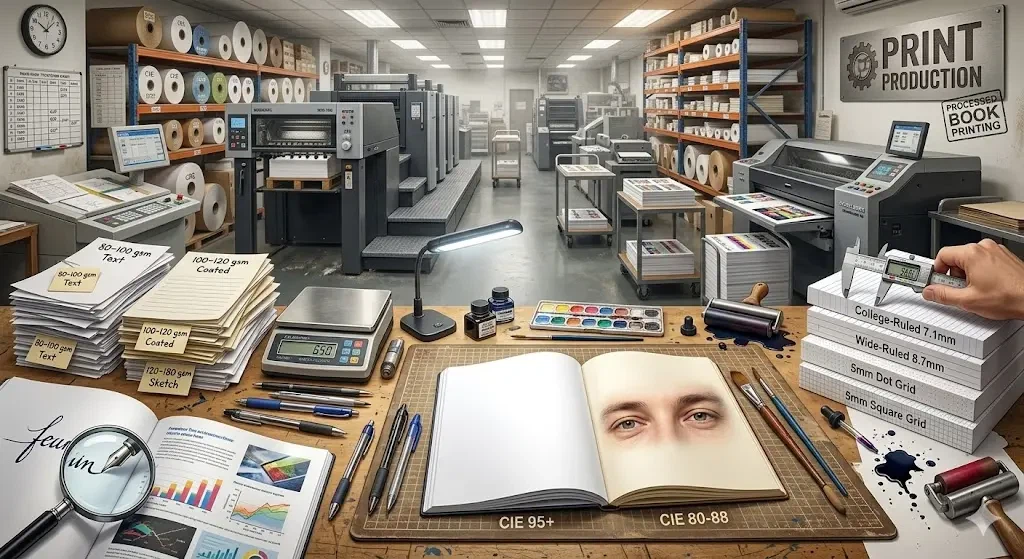
Weight is measured in grams per square meter (gsm). For everyday ballpoint and gel pens, 80 to 100 gsm is the sweet spot. Fountain-pen users need 100 to 120 gsm uncoated stock with minimal coating to prevent feathering. Sketchbooks jump to 120 to 180 gsm to support wet media. If you are still unsure which weight fits your end use, our article on the appropriate paper weight for book printing shows the math behind each range.
Finish controls how ink behaves on the page. Uncoated paper absorbs ink quickly and is preferred for handwriting. Coated stock resists absorption and is the right call for printed planners where designs and imagery are reproduced on the interior. Rule patterns - college-ruled at 7.1 mm, wide-ruled at 8.7 mm, 5 mm dot grid, 5 mm square grid - should match the end user rather than the designer's preference. For any notebook with printed interiors, color accuracy matters as much as weight; see our primer on color management in book printing for how CMYK profiling affects the finished sheet. Buyers comparing paper options against application can also browse types of paper for book printing to see how each stock behaves in production.
Shade affects eye strain and perceived tone. Bright white (CIE 95+) gives maximum contrast for design work. Natural or ivory (CIE 80–88) is gentler for long writing sessions and is the default for journals and novels.
Finishing Techniques That Elevate Brand Perception
Finishing is the step where two notebooks with identical binding, identical paper, and identical trim sizes diverge in perceived value. Each technique has a specific cost-to-impact ratio.
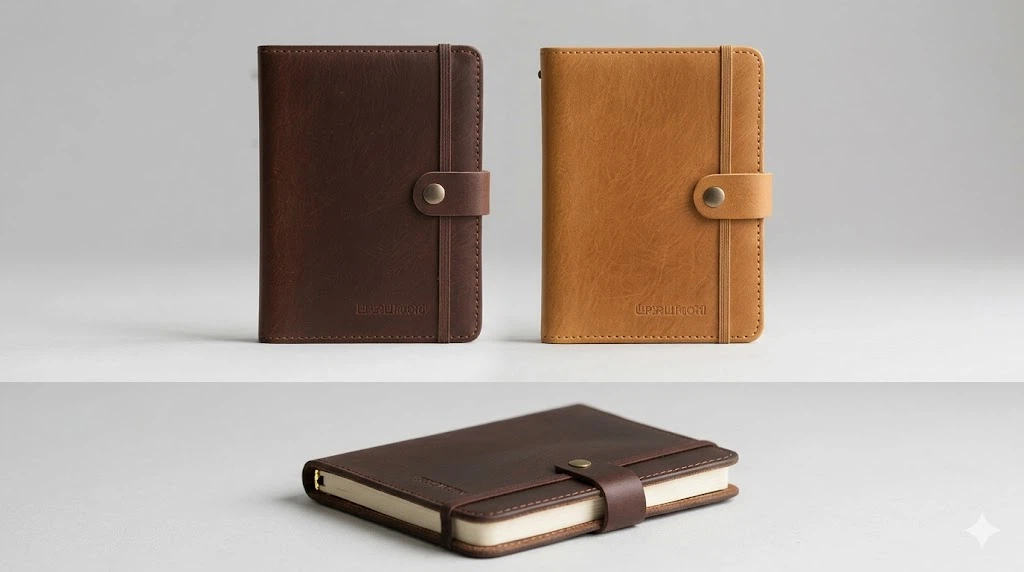
Foil stamping presses metallic or pigmented foil onto the cover under heat and pressure, producing a reflective, high-contrast mark. Gold, silver, rose gold, and holographic are the most requested finishes. Embossing and debossing raise or recess the cover artwork into three-dimensional relief, which photographs well for e-commerce and survives years of handling. Spot UV applies a glossy, raised coating over targeted areas, creating contrast against a matte background. Edge gilding or edge coloring treats the three trimmed edges of the text block, turning them into a design element at modest cost. Rounded corners, elastic closures, ribbon markers, and a back pocket are the four hardware accents most commonly added to executive and journal-grade notebooks.
Designing for Brand-Grade Results
A brand-grade notebook is not the same thing as a nicely printed one. The difference lies in how the design holds up against the physical realities of paper, pressure, and ink. A few principles we keep coming back to in pre-press reviews:
- Logo minimums. For debossing, keep stroke widths at 0.5 mm or wider. Thinner strokes either fail to register on fabric covers or create a muddy impression on PU leather.
- Brand color accuracy. If your brand uses a Pantone spot color, specify it - do not rely on the printer to match it from a CMYK build. Offset runs should follow the ISO 12647-2 standard for process-color reproduction.
- Safe margins. Keep any critical logo or text at least 5 mm from the trim edge and 10 mm from the binding edge - especially on perfect-bound or hardcover formats where the spine side is partially obscured.
- Multi-language layouts. Global brand rollouts often need covers that accept multiple character sets without losing proportion. Our note on printing multiple languages on leather notebooks covers the typography and layout choices that tend to survive production.
For brands that want the design integrated into a larger program - branded boxes, inserts, gift packaging - our OEM / ODM service handles the full development loop from concept to shipped units.
Sustainability Standards Worth Specifying
Corporate procurement increasingly requires environmental documentation, and three certifications move the decision.
FSC (Forest Stewardship Council) certification guarantees the paper originates from responsibly managed forests. PEFC offers an equivalent chain-of-custody standard widely accepted in Europe. Soy-based and vegetable-based inks lower volatile organic compound emissions compared with petroleum-based inks, and at commercial volumes they are typically cost-neutral. Recycled content should be specified as post-consumer waste (PCW) percentage - many papers labeled "recycled" actually contain only pre-consumer mill scrap, which has much less environmental meaning.
How to Evaluate a Notebook Printing Supplier
Specifications are only half the story. The other half is whether the factory can actually deliver them. The checklist we suggest buyers use when shortlisting a supplier:
- Do they provide a paid pre-production sample within 5 to 7 business days?
- Can they show current FSC or ISO certificates - not just mention them?
- What is their equipment base? Heidelberg, Komori, and Roland offset lines indicate commercial-grade color control.
- Do they handle export logistics and DDP pricing, or stop at factory gate?
- How do they handle a failed QC batch - rework, partial credit, or dispute?
- Is there a named point of contact, not just a generic sales inbox?
For insight into how we approach the quality side ourselves, our quality management page documents the inspection stages we run on every notebook order.
Production Timeline and Lead Time
A standard run of 500 spiral-bound notebooks with a printed cover typically ships 7 to 10 business days after artwork approval. Hardback notebooks need 10 to 15 business days because the case assembly and adhesive cure add time. Leather and specialty-material orders commonly extend to 12 to 18 business days, and sea freight adds 25 to 35 days to the US and Europe. Our breakdown on how long notebook printing takes covers variations by quantity and specification in more detail.
Pre-Order Checklist
- Final trim size confirmed and compared against paper yield
- Binding method selected with page count verified against minimum/maximum
- Cover material and finish confirmed with a physical swatch
- Interior paper weight, shade, and rule pattern signed off
- Artwork delivered as press-ready PDF, 300 dpi, CMYK, with 3 mm bleed
- Pantone references listed for spot colors
- FSC / PEFC requirement stated on the PO if needed
- Sample approved in writing before mass production begins
- Shipping terms (EXW, FOB, DDP) and incoterm confirmed
- Payment terms and delivery window agreed
Frequently Asked Questions
How much does custom notebook printing cost per unit?
Unit cost depends on binding, cover, page count, and quantity. As a working reference from our own 2024–2025 order book: saddle-stitched promotional notebooks at 1,000 units typically land between US $0.80 and $2.50 each; spiral-bound A5 journals at 1,000 units run $1.80 to $4.50; hardcover notebooks with foil-stamped leatherette cover at 500 units range from $4.50 to $9.00; full-grain leather editions at 300 units sit above $12.00. Always request a written quote against your exact spec - rule-of-thumb pricing varies by material sourcing and run size.
What is the minimum order quantity for a custom notebook?
Factory-direct MOQs generally start at 300 to 500 units for saddle-stitched and spiral-bound formats, and 500 to 1,000 units for hardback and leather editions. Short-run digital printing can handle quantities as low as 50 units, but the per-unit cost rises steeply compared with offset.
Can I choose any size for my custom notebook?
Yes. Standard sizes include A6 (105 × 148 mm), A5 (148 × 210 mm), B5 (176 × 250 mm), A4 (210 × 297 mm), 5.5" × 8.5", and 8.5" × 11". Custom trim sizes do not require new tooling, but unusual dimensions can reduce paper yield and affect the per-unit price.
What file format should I submit for printing?
A press-ready PDF at 300 dpi in CMYK color mode with a 3 mm bleed on all trimmed edges is the universal standard. Fonts should be embedded or outlined, and spot colors should carry Pantone references when exact color matching is critical.
What is the difference between Wire-O and spiral binding?
Spiral binding threads a single continuous coil through round punched holes. Wire-O uses pre-formed double-loop wire through rectangular holes, producing a more symmetrical, formal look. Spiral is generally cheaper; Wire-O is preferred when the notebook needs to look corporate on a desk.
How do I verify print quality before a full production run?
Request a physical pre-production sample. A proof in the intended paper, binding, and finishing confirms color accuracy, binding tightness, foil alignment, and trim quality. The five to seven business days it costs is the single most reliable way to avoid reprint disputes on a 5,000-unit order.
Are eco-friendly notebook options expensive?
Not as much as most buyers expect. FSC-certified paper carries a modest premium over non-certified equivalents; 100% post-consumer recycled stock sits above standard virgin paper; soy-based ink and water-based laminates are effectively cost-neutral at commercial volumes. Request specific pricing from your supplier against the exact material grade - the answer differs meaningfully between mills.
Summary
A brand-grade notebook is engineered, not merely printed. Lock down binding, trim size, cover, interior, and finishing before asking for a quote. Verify the supplier can back their specifications with samples, certificates, and named contacts. Insist on a physical proof before mass production, and document every spec on the purchase order in writing. Do that, and the notebook you ship will do what good stationery has always done - give the person holding it a reason to remember who it came from.


