

Custom greeting card printing is the production of folded or flat cards - for birthdays, client gifting, holidays, or retail - using digital or offset presses on cover-weight paper stock, typically 80–130 lb, with a specified fold type and surface finish. Those four variables together determine how the card reads in hand, survives mailing, and holds up over time on someone's desk.
Some cards get kept for months. Not because the message was longer or the design more elaborate, but because they physically felt worth keeping. That quality comes from specific production decisions - most of which cost less than first-time buyers assume. This guide covers all of them, from choosing between digital and offset printing to specifying the right paper weight and finish for your use case.
Whether you're ordering custom greeting cards for a seasonal client campaign, a retail collection, or a first-time personal project, the fundamentals covered here apply regardless of quantity or occasion.

Why Professionally Printed Greeting Cards Still Hold Attention
Physical mail and email occupy different cognitive registers. Multiple direct mail studies have found that recipients spend more time with physical pieces than digital messages and recall senders at higher rates - a pattern the USPS Household Diary Study has tracked consistently over several years. For businesses, that attention differential has real consequences: a well-produced card that sits on a client's desk for two weeks does more relationship work than three follow-up emails combined.
The scale of card sending in the US reflects this staying power. According to the Greeting Card Association, Americans purchase approximately 6.5 billion greeting cards each year, with nine out of ten households buying at least one annually. The US market was valued at $7.6 billion in 2024, according to Grand View Research - a figure that has held relatively stable despite the expansion of digital alternatives. The persistence isn't sentiment. Physical cards do something digital communication cannot: they signal deliberate effort in a way that clicking "send" simply doesn't.
For businesses specifically, the cost calculus is worth stating plainly. The difference between a mediocre card and a well-produced one is typically $0.40–$0.70 per unit. The difference in how the recipient perceives the sender is not marginal.
Card Format and Fold Types: The First Decision That Affects Everything Downstream
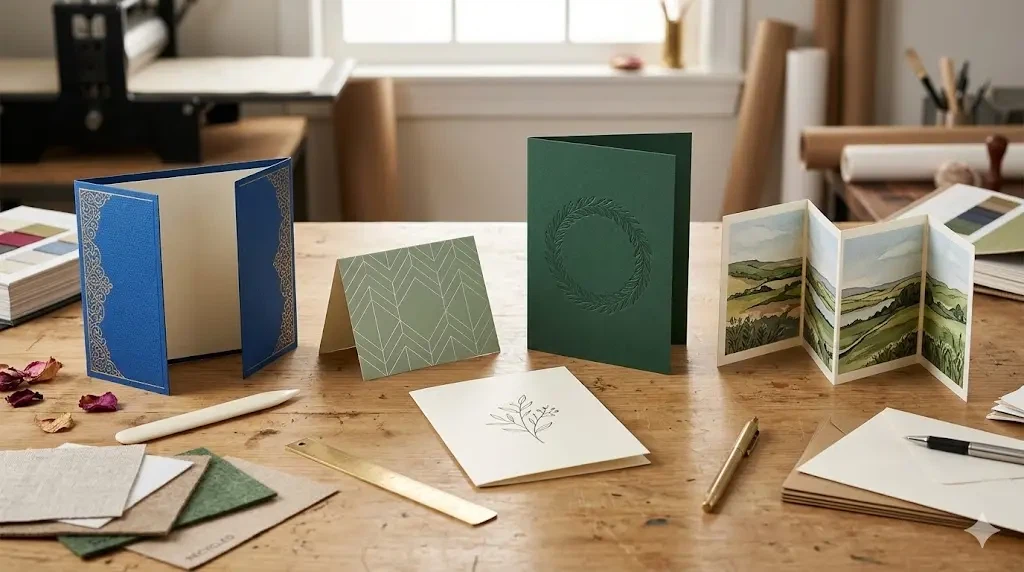
Format determines your artwork setup, scoring method, production cost, and the reader's physical experience of opening the card. Getting this right first avoids the most common downstream complications. The main options:
- Half-fold (standard): A single center fold, creating a front cover, inside spread, and back panel. The most widely used format by a significant margin. Standard finished sizes are 5×7 inches, 4×6 inches, and A2 (4.25×5.5 inches). Works for virtually every occasion and audience type.
- Flat card: No fold, printed one or two sides. Lower production cost and faster turnaround. Best for minimalist designs, bulk corporate mailings, or cards where the message is pre-printed rather than handwritten.
- Gatefold: Two front panels that open outward from the center. More expensive to produce, but delivers an unboxing experience that no standard fold can replicate. Used for luxury holiday campaigns, premium brand gifting, and high-end retail stationery.
- Tent fold: Scored so the card stands upright on a flat surface. Common for countertop promotions, event place cards, and in-store displays - less common for mailed pieces.
- Accordion / Z-fold: Multiple panels for extended content. Useful when the card doubles as a mini-brochure or multi-message campaign piece.
One technical note that catches first-time buyers: always build artwork at the full unfolded dimensions. A 5×7 inch finished card requires a 10×7 inch document. Keep critical design elements - text, faces, logos - at least 0.125 inches away from the fold line, and fold a physical mock-up before approving the final proof. Misaligned panels after scoring are the most common production complaint, and they're almost always preventable at the file setup stage.

Digital Printing vs. Offset Printing for Greeting Cards
Most greeting card guides skip this question entirely, which is why so many buyers end up either over-specifying for a short run or underutilizing offset for a large one. The choice between digital and offset printing is primarily a function of quantity and content type - though the two methods do produce different results worth understanding.
Digital printing uses toner or inkjet systems applied directly from a file, with no printing plates involved. Setup is fast, there's no meaningful minimum quantity, and per-unit costs stay relatively flat across small runs. It's the right choice for orders under approximately 500 cards, for personalized greeting card campaigns where each card carries different content - unique names, messages, or addresses - and when turnaround speed is a priority.
Offset printing transfers ink from a plate to a rubber blanket, then to the paper. Creating those plates adds upfront setup cost, but once the press is running, color consistency is more accurate and repeatable than digital, and per-unit costs drop sharply with volume. Offset becomes cost-competitive around 500–1,000 units and is substantially more economical at 5,000 cards or more. Pantone spot colors are achievable with offset but not standard digital - a distinction that matters for brand-critical color matching on coated or uncoated stocks.
The practical decision: under 500 units, or any run where each card carries personalized content, digital is the straightforward choice. For 1,000 or more identical cards where color fidelity and per-unit economics matter, offset wins. For high-volume production programs requiring consistent quality across large quantities, OEM manufacturing programs provide structured pricing and dedicated quality oversight at scale.
Paper Stock and Weight: The Spec That Signals Quality Before Anyone Reads a Word
Paper carries information before the design does. The weight of a card in hand, the sound it makes when picked up, whether it holds a score cleanly - these physical signals reach the recipient before a single word has been processed. Most buyers significantly underestimate this.
Start with the foundational rule: greeting cards need cover stock, not text stock. Text-weight paper - what brochures and newsletters are printed on - is too light to hold a fold correctly and communicates the wrong quality register the moment someone touches it. Cover stock, in the 80–130 lb range and above, is where all serious card production begins.
Within cover stock, the weight tiers break down like this in practice:
- 80 lb cover: Functional but light. Most appropriate for high-volume flat-card mailings where postage cost is a constraint.
- 100 lb cover: The production standard for most greeting card applications - enough substance for a professional result without significantly inflating per-unit cost. Most catalog-ordered cards land here by default.
- 130 lb cover: Noticeably heavier in hand. Recipients register the difference before unfolding. Brands that move their annual client holiday cards from 100 lb to 130 lb consistently find clients comment on the feel - often before reading the message. It's the spec most associated with the impression that a card was made with intention.
- 16pt / 18pt board: Maximum rigidity, used for premium retail cards and luxury gifting where the card itself should feel like an object worth keeping rather than just reading.
Surface texture is a separate variable from weight. Smooth coated stocks produce the sharpest color and are best for photography-heavy or bold graphic designs. Uncoated stocks accept pen ink cleanly - essential when the card has a signing area or blank interior for handwritten notes. Textured options like linen, felt weave, and laid add a tactile character that no coating can replicate, and they pair well with foil or embossing. A full technical reference for paper weights, fold configurations, and coating types across card production formats is worth reviewing before you finalize your order spec.

Surface Finishes: What Each One Actually Does
Finishes are functional decisions, not decorative ones. Each makes a specific trade-off between color vibrancy and writability, between tactile impact and cost, between visual polish and practical use. Choosing by instinct instead of intent is how good card designs end up with the wrong surface treatment.
Gloss UV coating intensifies color and hardens the surface against scuffing in transit. For photography-heavy designs or bold solid-color graphics, it punches the visual forward in a way matte doesn't. The limitation most buyers don't think about until it's too late: gloss resists pen ink. If any area of the card is intended for handwriting - a signing panel, a blank interior - gloss is the wrong finish for that surface.
Matte coating works in the other direction. It diffuses light rather than reflecting it, producing a result that reads as more editorial and refined. It accepts writing easily, which is why many corporate designers default to matte for client card programs: the finish looks polished and functions practically at the same time.
Soft-touch lamination is worth understanding as its own category rather than just a matte variant. It's a lamination with a microsuede texture - the kind that makes recipients run their thumb across the surface before reading anything. The sensation is difficult to describe and immediately recognizable in person, which is exactly why it's become the preferred finish for premium B2B gifting. It carries a higher cost than standard matte or gloss, and it's not writable, so plan card interiors accordingly.
Spot UV functions differently from full-surface coatings. It applies a high-gloss layer to specific design elements - a logo, a border, a headline - against a matte background. The result is both visual and tactile contrast, useful when you want to direct attention to one element rather than treating the entire surface uniformly.
Foil stamping - gold, silver, copper, or holographic - is the option that doesn't photograph well, which is practically its main advantage. It announces itself in person through a physical presence that digital reproduction cannot convey accurately. For holiday cards and luxury retail stationery, the impact-per-dollar ratio still favors foil over most alternatives, provided the quantity justifies the plate setup cost.
One point worth noting: a 130 lb uncoated card with no finish treatment can outperform a coated card of lower weight. Stock weight communicates quality independently of surface treatment. Finish is a tool, not a requirement - and the right choice follows the card's purpose, not default assumptions about what "premium" looks like.
Color Mode, Resolution, and File Setup
Three technical errors account for the majority of print quality complaints on greeting card jobs. Each is entirely preventable if caught before file submission.
Color mode. Screens display in RGB. Commercial printing runs in CMYK. The conversion between them shifts colors - sometimes slightly, sometimes significantly. Saturated reds, electric blues, and vibrant greens are the most vulnerable: colors that look vivid on a monitor can print noticeably duller without a deliberate CMYK conversion during the design phase. Adobe's documentation on color modes explains the underlying gamut difference precisely, and it's worth reading once before your first print project.
Bleed. Any background color or image that extends to the card's cut edge needs 0.125 inches of bleed beyond that edge in the file. Without it, small variations in cutting leave a white sliver along one or more edges. Low-cost online design tools omit bleed from their default templates more often than not - it's the detail that most visibly signals whether a file was set up for professional print or built for screen.
Image resolution. Print requires 300 dpi at the final output size. A photograph that looks sharp on a high-resolution monitor may be 72 dpi - it will print visibly blurry at 5×7 inches. Check every placed image in your file before submitting, not just how the composite looks on screen.
PDF is the standard submission format for professional print production. Export with CMYK color mode, 300 dpi minimum, 0.125-inch bleed on all edges, and fonts embedded or converted to outlines. InDesign and Illustrator both produce reliable print-ready PDFs. Photoshop works for single-panel flat designs but is less dependable for multi-panel folded layouts, particularly when panels contain images assembled from multiple sources at different resolutions.
Holiday Cards, Personalized Greeting Cards, and Bulk Orders: What Changes at Scale
Individual consumers ordering 50 birthday cards and marketing teams producing 10,000-card holiday campaigns have different priorities - but they share one: what gets printed has to work for the person receiving it, not just the person ordering it.
For personal and small-batch orders, the highest-return production decision is almost always paper weight. Upgrading from a default 100 lb matte card to 130 lb typically adds $0.20–$0.35 per unit at small quantities. That's usually a more impactful investment than switching to a more elaborate finish or a more complex fold.
For business holiday cards and personalized greeting card campaigns, variable data printing (VDP) deserves specific attention. VDP allows each card in a production run to carry different content - unique recipient names, personalized messages, individual addresses - without separate print jobs. A 500-card client mailing where every card is individually addressed costs nearly the same per unit as a generic 500-card run. The perceived personalization is in a different category entirely, and it's one of the most underutilized capabilities in B2B card programs.
Large-scale bulk greeting card printing introduces a third consideration: color consistency across the full run. CMYK approximations are sufficient for most designs, but brand-critical colors - a specific Pantone value in a logo, a primary brand color on coated stock - should be specified explicitly. CMYK mixes that look accurate on screen can drift on paper, particularly on uncoated stocks where ink absorption varies by batch. For how production tolerances are managed across large card runs, the quality management process applied to card and print orders outlines the control steps in detail.
Eco-Friendly Greeting Card Printing: What the Spec Actually Means
Sustainability in print is a real specification set, not a tone of voice. Knowing what to ask for separates meaningful environmental sourcing from vague positioning.
FSC certification means paper was sourced from forests operating under Forest Stewardship Council standards - a third-party audited system, not a self-declaration. If environmental sourcing is part of your brand positioning or procurement requirements, FSC is the baseline specification to require and verify.
Post-consumer waste (PCW) recycled content refers specifically to fiber that has completed a consumer use cycle. This is meaningfully different from pre-consumer waste (mill off-cuts), which carries different environmental implications. Modern 100% PCW cover stocks print comparably to virgin paper. The practical difference is a slightly warmer base white - a characteristic that many designers find more natural-looking than bright-white coated sheets, and that some specifically select for a less corporate visual register.
Soy-based and vegetable-based inks replace petroleum-derived chemistry with renewable alternatives that are also more easily removed during paper recycling. Color output is comparable to standard inks for all typical greeting card applications.
Adding a single line to the back of your card - "Printed on FSC-certified stock using soy-based inks" - adds nothing to production cost. An increasing share of recipients notice, and it matters to a larger portion of them than most print buyers expect.
Greeting Card Packaging: When the Presentation Extends Beyond the Card
When cards ship as part of a larger gift, branded kit, or retail seasonal collection, the packaging is not a separate product decision - it's part of the same experience, and it needs to be designed alongside the card, not after it.
A well-produced card inside a plain white envelope reads one way. The same card arriving in a structured custom printed gift box with branded tissue and a wax seal reads entirely differently - before anyone has opened anything. The packaging sets the frame. For B2B gifting programs, premium stationery kits, and retail seasonal collections, that frame is part of what's being communicated to the recipient.
For multi-piece corporate gift kits, collapsible rigid boxes ship flat and assemble at the fulfillment stage, which reduces shipping volume without sacrificing the tactile quality of a rigid structure on arrival. This is standard practice in corporate gifting programs and independent stationery brands that need to ship premium packaging economically at volume. When a card ships alongside other materials - a branded notebook, a product sample, a promotional insert - the custom packaging structure needs to be dimensioned around all those components from the start, not retrofitted around the card as an afterthought.
For a detailed breakdown of standard and custom size options across gift box formats, the custom gift box sizing guide covers the decision points across product dimensions. On the production side, gift box printing specifications and greeting card print specs overlap meaningfully - particularly around coating choices, color matching, and stock selection - which is why planning both products with the same supplier typically produces more visually coherent results than sourcing them separately.
Frequently Asked Questions About Greeting Card Printing
What paper weight should I use for greeting cards?
For most applications, 100–130 lb cover stock is the right range. At 100 lb, you get a solid, professional card that works well across standard formats without driving up per-unit cost. At 130 lb, the physical weight becomes part of the message itself - recipients register the difference before they unfold the card. Avoid text-weight paper entirely; it doesn't hold a fold correctly and communicates the wrong quality level immediately to anyone who handles it.
What is the standard size for a custom greeting card?
The most common finished size in the US is 5×7 inches (folded), which fits a standard A7 envelope. Other widely used sizes include 4×6 inches (A6 envelope), 4.25×5.5 inches (A2 envelope), and square formats at 5×5 or 6×6 inches. For cards that will be mailed, matching standard USPS envelope dimensions is important - non-standard dimensions can trigger additional postage costs or special handling requirements that add up across large runs.
What is the minimum order quantity for custom greeting cards?
Digital printing typically accommodates orders from 25–50 units with minimal setup cost. Offset printing becomes cost-competitive at 500–1,000 units, where fixed setup costs are spread across a large enough run to make the per-unit economics favorable. Professional manufacturers serving corporate and retail programs typically work with minimum quantities of 1,000–5,000, depending on production method, paper specification, and finishing options. For personalized greeting cards where each piece carries different content, digital short-run printing is the most practical path regardless of total quantity.
What is the difference between digital and offset greeting card printing?
Digital printing has no plate setup cost, accommodates small quantities and personalized content easily, and produces results that are excellent for most applications. Offset printing requires plate setup but delivers more accurate color consistency at volume, makes Pantone spot colors achievable, and has a significantly lower per-unit cost above approximately 1,000 units. The decision is primarily a quantity and content-type question: digital for short or personalized runs, offset for large identical batches where brand color accuracy and per-unit economics are priorities.
What file format should I submit for professional greeting card printing?
PDF is the standard. Export with CMYK color mode, 300 dpi minimum image resolution, 0.125-inch bleed on all edges, and fonts embedded or converted to outlines. InDesign and Illustrator both export reliable print-ready PDFs. Photoshop works for single-panel flat designs but is less reliable for multi-panel folded layouts. If your print supplier provides a template for your specific card size and fold, building within that template eliminates the most common file setup errors before review.
Can I print eco-friendly greeting cards without compromising quality?
Yes, and the quality gap has narrowed considerably over the past decade. FSC-certified and post-consumer recycled stocks are available in weights up to 130 lb cover and print comparably to virgin papers at standard resolution. The main practical difference is a slightly warmer base white on recycled stock - a characteristic many designers prefer over the clinical brightness of standard coated sheets. Soy-based inks perform equivalently to standard inks for all typical greeting card applications and add no meaningful cost premium at production quantities.
Xingwei produces custom cards and print materials across formats, paper specifications, finishes, and coordinated packaging - with 30-plus years of manufacturing experience and production capabilities for both short digital runs and high-volume offset programs. To discuss specifications for your next card project, contact the team directly.


