

This guide walks through every major FDA food labeling requirement in practical order - what goes on the label, where it goes, how it must be formatted, and what has changed through 2025. It also covers two questions that most guides skip entirely: which products are exempt, and where FDA jurisdiction ends and USDA begins.
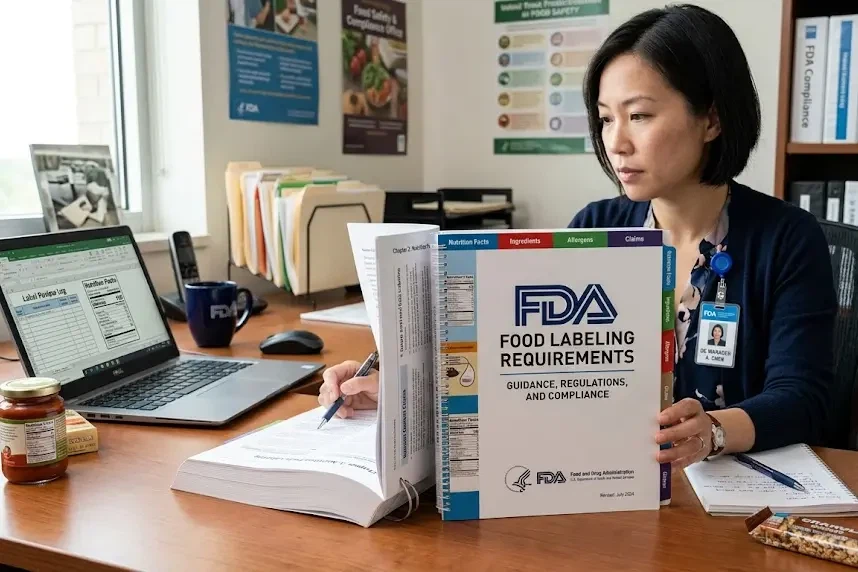
FDA vs. USDA: Which Agency Governs Your Product?
This is the most consequential scoping question in food labeling, and it catches manufacturers off guard regularly. The answer determines which regulations apply, which agency inspects your labels, and whether you need pre-approval before printing.
The FDA covers the majority of packaged foods: snacks, beverages, dairy, seafood, baked goods, canned goods, candy, condiments, dietary supplements, and more. Its food labeling regulations sit primarily in 21 CFR Part 101.
The USDA's Food Safety and Inspection Service (FSIS) governs meat, poultry, and processed egg products - chicken breasts, ground beef, deli meats, pepperoni, liquid whole eggs, and similar products. FSIS operates under different statutory authority, runs its own pre-approval process for certain label statements, and has distinct requirements for handling claims and safe handling instructions. For those products, start at USDA FSIS food labeling guidance, not FDA's.
Mixed products - a frozen pizza with a meat topping, a soup containing chicken - generally fall under USDA jurisdiction when meat or poultry is a significant component. The exact thresholds vary by product category; when in doubt, contact USDA FSIS directly to confirm jurisdiction before investing in label design.
The remainder of this guide covers FDA-regulated products only.

Which Products Are Exempt from FDA Labeling Requirements?
Not every FDA-regulated food requires a full compliance label. Understanding the exemptions saves time and avoids unnecessary compliance costs for products that don't need them - but the conditions matter.
- Small business nutrition labeling exemption: Manufacturers with fewer than 10 full-time equivalent employees who sell fewer than 10,000 units of a given product annually may qualify for an exemption from nutrition labeling under 21 CFR 101.9(j). This exemption covers only the Nutrition Facts panel. Allergen labeling, the ingredient statement, and the Statement of Identity remain required regardless of company size.
- Restaurant and food service: Food prepared and sold at restaurants, cafeterias, and similar establishments is generally exempt from packaged food labeling requirements. Chain restaurants with 20 or more locations fall under separate FDA menu labeling rules.
- Raw produce and bulk foods: Fresh fruits and vegetables sold individually, and food sold directly from bulk bins or containers, are typically exempt from full labeling. Voluntary nutrition information programs apply to the most commonly consumed raw produce.
- Same-establishment retail: Food prepared and sold at the same retail location - a bakery selling its own products in-store, for example - may qualify for exemption. Distribution beyond that location changes the analysis.
These exemptions have conditions, cross-ownership rules, and edge cases. If your distribution model is growing or changing, verify your eligibility against current FDA guidance before assuming an exemption still applies.
Required Elements on Every FDA-Regulated Food Label
A compliant FDA label is organized across three zones. Each has mandatory content and formatting rules that are specified in regulation - not guidelines.
The Principal Display Panel
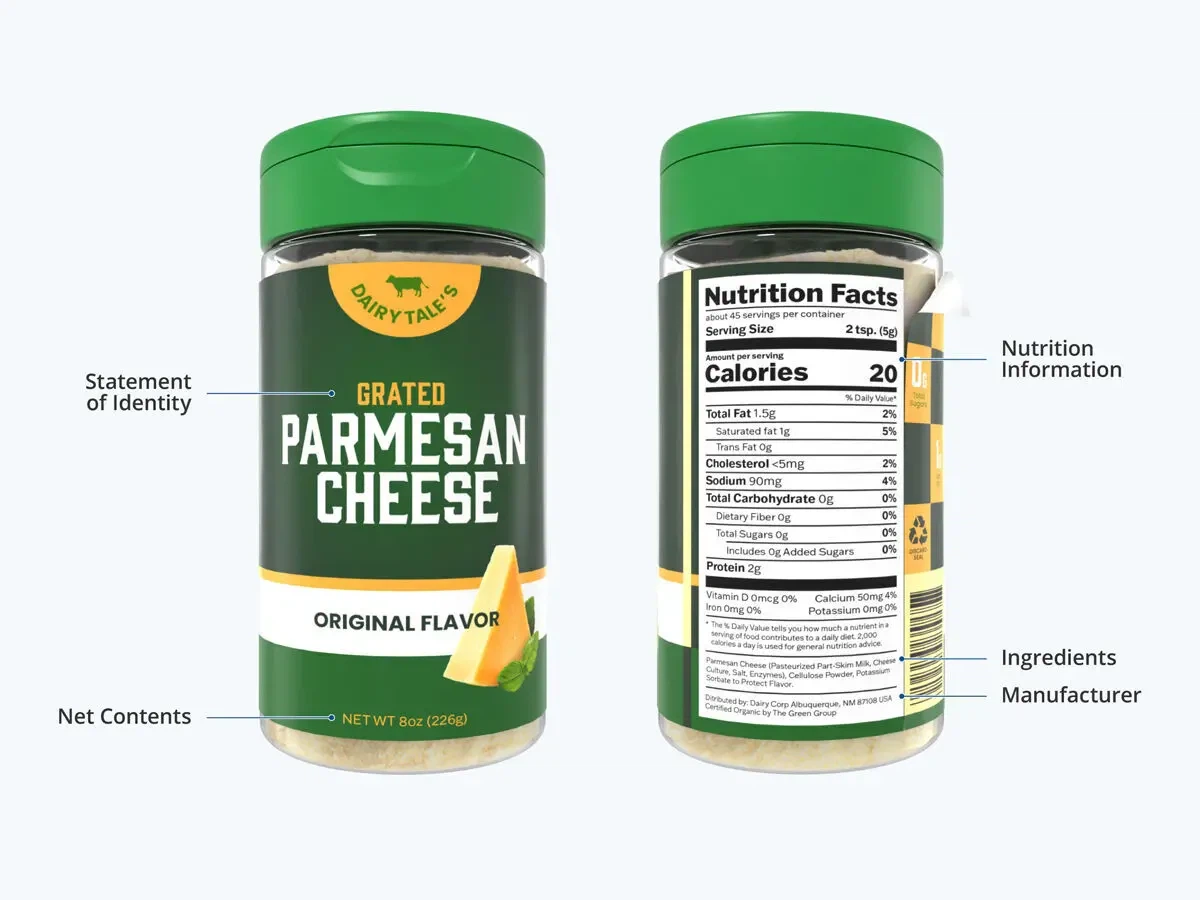
The Principal Display Panel (PDP) is the front face of the package - the surface most likely to be displayed at retail. Two mandatory items live here.
The Statement of Identity declares the legal or common name of the food. If a federal standard of identity exists for your product type under 21 CFR (for example, cheddar cheese or mayonnaise), you must use that standardized name. If no standard exists, use a descriptive term that accurately characterizes what the product is. Brand names and invented names are not acceptable substitutes.
The Net Quantity of Contents - the amount of food in the package - must appear in the lower 30% of the PDP in both US customary units (oz, lb, fl oz) and metric units (g, kg, mL). Minimum type size is determined by the total area of the PDP; FDA regulations specify a bracketed size chart that applies based on that area. This is one of the most common technical violations cited in FDA warning letters.
When packaging has alternate PDPs - panels the consumer is equally likely to see first - each must carry the Statement of Identity and net quantity.
For brands designing custom box packaging or retail-ready product box printing, these placement rules need to be factored into the layout before the design is finalized.
The Information Panel
The information panel sits immediately to the right of the PDP, or the next panel clockwise when the PDP occupies a full face. Three mandatory elements belong here.
The ingredient statement lists every ingredient by its common or usual name, in descending order of predominance by weight. Water appears first if it weighs more than anything else. Compound ingredients (a sauce, a seasoning blend) can list their subingredients parenthetically. Minimum type size is 1/16 inch - this is a hard floor, not a starting point for design tradeoffs.
The manufacturer, packer, or distributor name and address must be sufficient for delivery. If the entity named on the label did not manufacture the product, a qualifier is required: "Manufactured for," "Distributed by," or "Packed by." Omitting this qualifier when it applies is a misbranding violation. If the address doesn't appear in public directories, a full street address is required.
The allergen declaration also belongs on the information panel, covered in detail in the next section.
The Nine Major Food Allergens
Many label templates and compliance guides still list eight major food allergens. That number is wrong as of January 1, 2023. The FASTER Act of 2021 added sesame as the ninth FDA-recognized major food allergen, with mandatory declaration effective January 1, 2023. If your label template predates that date, assume it needs review.
The nine major allergens are: milk, eggs, fish (species must be specified, e.g., "salmon"), shellfish (species must be specified, e.g., "shrimp"), tree nuts (species must be specified, e.g., "almonds, cashews"), peanuts, wheat, soybeans, and sesame.
For current FDA guidance on allergen declaration, consult the 2025 Allergen Q&A Guidance (Edition 5), which supersedes Chapter 6 of the FDA's 2013 Food Labeling Guide.
Allergens can be declared in either of two formats, and both can be used together:
- In parentheses within the ingredient list: flour (wheat), whey (milk)
- In a separate "Contains" statement following the ingredient list: Contains: wheat, milk, sesame
For tree nuts, fish, and shellfish, using only the group name ("tree nuts") without specifying the species does not satisfy the requirement. A product containing both cashews and almonds must name both.
Products with complex ingredient profiles - including custom cannabis packaging and other heavily regulated consumer goods - face similar labeling obligations where allergen-containing ingredients are present.
The Nutrition Facts Panel
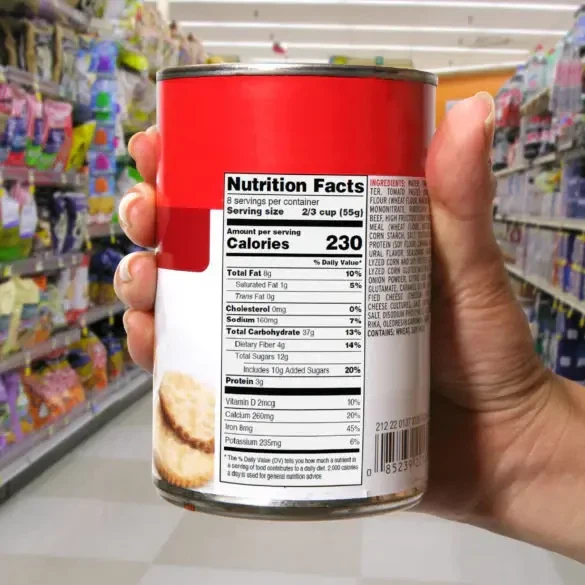
The current Nutrition Facts format was finalized in 2016 and became mandatory for large manufacturers in January 2020, with small manufacturers required to comply by January 2021. Labels still using the pre-2016 format are non-compliant. Key requirements under the 2016 final rule:
- Serving sizes must reflect the amount people typically eat, based on updated FDA reference amounts customarily consumed (RACCs). Manufacturers cannot use arbitrarily small serving sizes to make calorie counts look lower.
- Calories per serving must appear in the largest, boldest type on the panel.
- Added sugars must be declared as a separate line item under Total Sugars, with a Percent Daily Value.
- Vitamin D and Potassium are now mandatory declarations. Vitamins A and C are no longer required (though they may be declared voluntarily).
- "Calories from Fat" has been removed from the current format.
- All text in the Nutrition Facts box must be at least 6 points.
Dietary supplements use a Supplement Facts panel rather than a Nutrition Facts panel. The formats, required items, and serving size conventions differ. Using the wrong panel type on a product is a labeling violation.
2025 Update: The Proposed Front-of-Package Rule
On January 16, 2025, the FDA published a proposed rule that would require a standardized nutrition label on the front of most packaged foods. The proposed "Nutrition Info box" would show the Percent Daily Value per serving for three nutrients identified as commonly overconsumed in the 2020–2025 Dietary Guidelines: saturated fat, sodium, and added sugars. Each would be rated High, Medium, or Low based on its %DV per serving.
This is a proposed rule - it has not been finalized, and manufacturers are not currently required to add a front-of-package label. However, the rulemaking process is underway, and brands planning new custom box packaging materials and styles or major packaging redesigns should consider leaving space for a front-panel nutrition element in their structural design.
Nutrient Content Claims and Health Claims
Any statement on your label about the level of a nutrient - "low fat," "sugar-free," "excellent source of fiber" - is a nutrient content claim, and it triggers specific compliance requirements. These thresholds are defined in 21 CFR Part 101 Subpart D.
| Claim | FDA Threshold |
|---|---|
| "Fat free" | Less than 0.5g fat per serving |
| "Low fat" | 3g or less fat per serving |
| "Reduced fat" | At least 25% less fat than the reference food |
| "Sugar free" | Less than 0.5g sugar per serving |
| "Low sodium" | 140mg or less sodium per serving |
| "High" / "Excellent source of" | 20% or more of %DV per serving |
| "Good source of" | 10–19% of %DV per serving |
When a nutrient content claim appears on any panel, the corresponding nutrient and its value must appear in the Nutrition Facts panel. Claim font size cannot exceed twice the size of the Statement of Identity.
Health claims - statements that imply a relationship between a food or nutrient and a disease - are more tightly controlled. Authorized health claims (for example, the relationship between sodium and blood pressure) are listed in regulation. Qualified health claims are permitted with mandatory disclaimers. Using an unauthorized health claim triggers regulatory action even if the underlying statement is accurate.
Special Label Claims: What the FDA Actually Allows
Gluten-Free
The FDA defines "gluten-free" as containing less than 20 parts per million (ppm) of gluten. The standard applies whether the product is inherently gluten-free (e.g., fresh produce) or has been specifically formulated to meet the threshold. Labeling a product "gluten-free" when it doesn't meet that standard is misbranding.
Organic
Organic claims on food labels are regulated by the USDA National Organic Program (NOP), not the FDA. Using "USDA Organic" or "100% Organic" requires certification by a USDA-accredited certifying agent. The FDA does not grant organic certification, though it can take action for misbranding if an organic claim is false or misleading.
Natural
The FDA has never formally defined "natural" in regulation. Its longstanding informal policy treats "natural" as meaning the food contains no artificial or synthetic ingredients (including artificial colors) and is not more than minimally processed. This policy has no regulatory force, and the FDA has repeatedly acknowledged it may need a formal rulemaking. Using "natural" on a product that contains artificial flavors, synthetic preservatives, or ingredients produced through significant chemical processing carries real enforcement and consumer litigation risk.
Healthy
The FDA finalized an updated definition of "healthy" in September 2024. Under the new rule, a food may only be labeled "healthy" if it:
- Contains a meaningful amount of food from at least one food group or subgroup recognized in the Dietary Guidelines (fruits, vegetables, grains, dairy, or protein foods), and
- Meets updated per-serving nutrient limits for saturated fat, sodium, and added sugars, with thresholds that vary by food category. For example, most foods must contain no more than 10% DV of saturated fat, and beverages must contain no more than 5% DV of added sugars per serving.
The prior definition - which focused on total fat and cholesterol and famously excluded foods like nuts and salmon - has been replaced. Brands currently using "healthy" on labels should verify compliance against the 2024 criteria before the rule's compliance date.
Seven Labeling Mistakes That Trigger FDA Action
These are the errors that appear repeatedly in FDA warning letters and import alerts. Each one is fixable before it becomes a problem.
1. Using an invented name instead of a standardized identity name. Federal standards of identity exist for hundreds of food types - yogurt, cream cheese, peanut butter, mayonnaise, and many more. If a standard applies to your product, you must use the regulated name or clearly disclose any deviation. A product that doesn't meet the standard for "peanut butter" (for example, one with added hydrogenated oil) must be called something else, such as "peanut spread."
2. Declaring allergens only in the "Contains" statement while listing ingredients by technical names. A product listing "casein" in the ingredient statement without the parenthetical "(milk)" is relying entirely on the "Contains: milk" statement for allergen disclosure. If the "Contains" statement is ever removed or overlooked by a consumer, the ingredient list alone doesn't protect them. Use both formats wherever possible.
3. Missing sesame. Templates and label review workflows built before 2023 don't include sesame as a required declaration. This is now the most common allergen labeling gap in products that were compliant before the FASTER Act took effect. Any label last reviewed before January 2023 should be audited.
4. Wrong type size on the PDP. The minimum type size for the net quantity statement is calculated from the area of the PDP, using a bracketed formula in 21 CFR 101.105. A label designed at 8pt type on a small pouch may be non-compliant because the formula requires a larger minimum for that particular PDP area. This is one of the leading technical violations in FDA enforcement letters against imported products.
5. Front-panel claims that aren't supported in the Nutrition Facts panel. A "high in fiber" claim on the front panel requires that fiber appear as a declared nutrient in the Nutrition Facts panel - and that the value actually meets the 20% DV threshold. Brands sometimes add claims during copy revisions without updating the Nutrition Facts accordingly.
6. Missing or incorrect manufacturer qualifier. If the brand name on a label belongs to a company that didn't manufacture or pack the product, a qualifying phrase is required. "Manufactured for [Brand]" or "Distributed by [Brand]" is not optional - it's a misbranding issue. Private label products are especially prone to this oversight.
7. Pre-2016 Nutrition Facts format still in use. Labels showing "Calories from Fat" as a line item, or listing Vitamins A and C as mandatory nutrients, are using the old format. The compliance deadline for large manufacturers passed in January 2020. If a label hasn't been updated since then, the Nutrition Facts panel is non-compliant.
How to Review a Food Label Before It Prints
Run through these six checkpoints any time you're finalizing a new label or updating an existing one.
Step 1 - Confirm jurisdiction. Does the product contain meat, poultry, or processed egg products as a primary component? If yes, the relevant agency is USDA FSIS, not FDA. This guide doesn't apply.
Step 2 - Review the PDP. Is the Statement of Identity the correct legal or common name? Is the net quantity in the lower 30% of the PDP in both customary and metric units? Do the type sizes for both elements meet the CFR minimum for this PDP area?
Step 3 - Review the information panel. Is the ingredient list in descending weight order, using common names, at minimum 1/16-inch type? Are all nine major allergens present in the product declared - including sesame? Is the manufacturer/distributor name present with the correct qualifier?
Step 4 - Review the Nutrition Facts panel. Is the current post-2016 format in use? Are calories in the largest, boldest type? Is added sugar a separate line with %DV? Are Vitamin D and Potassium declared? Is "Calories from Fat" absent?
Step 5 - Audit voluntary claims. For every nutrient content claim, health claim, or special term anywhere on the label, verify the product meets the corresponding regulatory threshold and that the supporting data appears in the Nutrition Facts panel.
Step 6 - Check the business address. Is the address current and deliverable? If the company has moved, updated the label. If the named entity didn't manufacture the product, is the qualifier phrase present?
Understanding how a label's text and structure interact with the physical packaging is also part of the compliance picture. See product label types, key parts, and design tips for a practical breakdown of how label zones map onto different packaging formats, including folding cartons and rigid boxes.
FDA Food Label Compliance Checklist
Use this as a final pre-print review before sending files to your printer.
Principal Display Panel
- Statement of Identity uses the correct legal or common name
- Net Quantity in lower 30% of PDP in both US customary and metric units
- Type sizes for SOI and Net Quantity meet 21 CFR minimums for this PDP area
- No false or misleading imagery or text
Information Panel
- Ingredient list in descending weight order, common names, minimum 1/16-inch type
- All 9 major allergens declared: milk, eggs, fish (species), shellfish (species), tree nuts (species), peanuts, wheat, soy, sesame
- Manufacturer/packer/distributor name and current address
- Qualifying phrase used if named entity is not the manufacturer
Nutrition Facts Panel
- Post-2016 format in use - "Calories from Fat" absent
- Serving size reflects current RACC
- Calories in largest, boldest type
- Added sugars as separate line with %DV
- Vitamin D and Potassium declared
- All text at minimum 6-point size
Claims
- Each nutrient content claim meets its 21 CFR Part 101 threshold
- Health claims are FDA-authorized or carry required qualifying language
- "Gluten-free" claim meets the <20 ppm standard
- "Healthy" claim meets the 2024 finalized criteria
- "Natural" claim has been reviewed for compliance and litigation risk
- "Organic" is backed by valid USDA NOP certification
For food products that ship in custom printed corrugated boxes or custom folding boxes, the checklist applies to the product label as well as any labeling claims printed directly on the outer shipping carton.
Frequently Asked Questions
Does the FDA require expiration dates on food labels?
No. With the exception of infant formula, the FDA does not mandate expiration, best-by, or sell-by dates on packaged food labels. Many states have their own date labeling laws for specific food categories, and USDA-regulated products have separate requirements. Brands distributing nationally should check state-level rules alongside federal ones.
What are the FDA labeling requirements for food sold online?
The same requirements that apply to food sold in physical retail apply to food sold online. The FDA's position is that the full labeling disclosure - Nutrition Facts, ingredient statement, allergen declaration, Statement of Identity, and net quantity - must be accessible to consumers before purchase, either on the packaging image or in a separate labeling display on the product page. This matters for DTC food brands and marketplace sellers. If a product ships without meeting the standard labeling requirements, the label itself is non-compliant regardless of where the sale occurred.
Do small food businesses have to follow FDA labeling rules?
Generally yes. A narrow nutrition labeling exemption exists for manufacturers with fewer than 10 FTE employees selling fewer than 10,000 units annually per product, under 21 CFR 101.9(j). That exemption covers only the Nutrition Facts panel - allergen labeling, the ingredient list, Statement of Identity, and net quantity are required regardless of company size. The exemption is also lost if the product is distributed by or sold to a company that doesn't qualify.
What happens if my food label is non-compliant?
Consequences scale with severity. Minor technical violations - incorrect type size, missing qualifier phrase - typically result in an FDA warning letter, which is public, on record, and requires a written response with a corrective action plan. Undeclared allergens or substantially false labeling can trigger voluntary recalls, mandatory recalls, import detention, or injunctive action. FDA warning letters related to food labeling are publicly searchable at fda.gov and frequently cited by retailers and importers when reviewing supplier compliance.
Does the FDA require expiration dates on food labels?
No. With limited exceptions (infant formula), expiration and best-by dates are not federally mandated by the FDA for most packaged foods. Individual states may have different rules.
Is front-of-package labeling currently required?
No. The FDA's proposed Front-of-Package Nutrition Info box rule (January 2025) has not been finalized. FOP labeling is voluntary at this time.
Where can I find the current FDA food labeling regulations?
The core regulations are in 21 CFR Part 101, available at eCFR.gov. The FDA's 2013 Food Labeling Guide remains useful for structural context, but Chapters 6 (allergens) and 7 (nutrition labeling) have been superseded. For allergens, use the 2025 Allergen Q&A Guidance (Edition 5). For the Nutrition Facts format, use the 2016 final rule and FDA's current Industry Resources page.
Next Steps
Three things are worth checking right now regardless of where your products are in their labeling lifecycle:
- Allergen declarations include sesame - required since January 1, 2023
- Nutrition Facts panels use the post-2016 updated format
- Any use of "healthy" has been reviewed against the 2024 final definition
For products entering distribution for the first time, a formal review against 21 CFR Part 101 - and a conversation with a food regulatory attorney or consultant - is the right investment before printing. The FDA does not pre-approve food labels; once a non-compliant label is in market, the correction cost is yours.
If you're in the process of designing or reprinting packaging, see types of packaging boxes and print methods for custom boxes for guidance on how packaging format and print process choices interact with label placement requirements. For finished product packaging with food package boxes or printed food packaging boxes, working label compliance into the design brief from the start avoids costly revisions later.
This article is for informational purposes and reflects FDA requirements as understood at the time of publication. Regulations change. Verify current requirements against official FDA guidance and applicable CFR sections before finalizing any label.


